
Gold: US retail sales trigger new crash
"Heartbroken once again for gold bulls," said market commentator Adam Button.
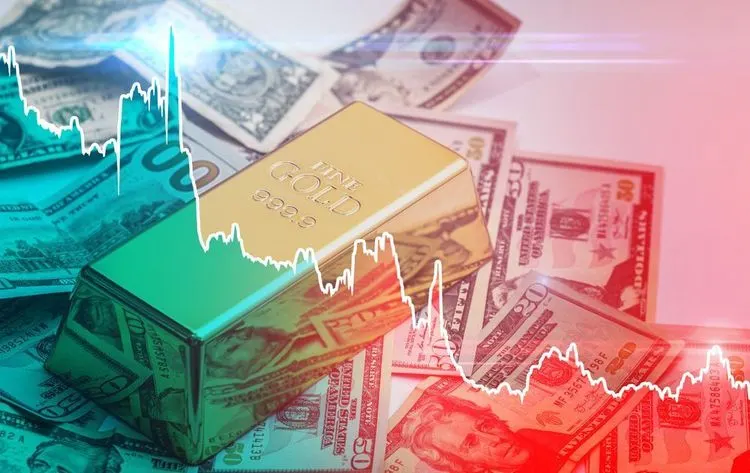
Gold plunged to a five-week low below $ 1,750 on Thursday after U.S. retail sales surged more than 15% in August and the economy was drenched after weeks of difficult data on the Delta variant of Covid. The most active December contract for gold futures on New York's Comex fell $ 43.75, or 2.4%, to $ 1,751.05 by 10:25 a.m. (14:25 GMT). The session's low was $ 1,745.50, its lowest since August 12th. "Heartbroken once again for gold bulls," said market commentator Adam Button in a post on ForexLive. "(It) cannot get a boost from weak inflation, (and is) crushed by retail sales." The US consumer price index, a key measure of inflation, rose 5.3% in August, after rising 5.4% in July, announced earlier this week. "Gold has fallen out of favor, and it's been falling out of favor quickly," said Craig Erlam, an analyst at the online trading platform OANDA. "This comes just a few days after it climbed back above $ 1,800 on weaker US inflation data. Those cheers were short-lived and suddenly look pretty vulnerable." Erlam said technically the price of gold at $ 1,780 marks the neckline of a head and shoulder movement that began last month and peaked at $ 1,833. "The fact that this happened ahead of the Fed meeting does not bode well for the yellow metal," said Erlam. "The latest data has given the Fed leeway to be more patient with tapering, but the comments we heard from officials late last week suggest that many are not discouraged. Gold may go all over again Get going if policymakers change course next Wednesday, but it could be a long week for the yellow metal in the meantime. " Markets are louder than usual on US economic data this week as the Federal Reserve slips into its typical blackout period ahead of its September 21-22 meeting. The question of when the Fed should cut its stimulus measures and raise rates has been hotly debated in recent months as the economic recovery collides with the reappearance of the delta variant of the corona virus. Chairman Jay Powell will hold a press conference next week after the Fed's two-day meeting. The Fed's stimulus package and other monetary policy measures have been blamed for exacerbating price pressures in the United States. The central bank has bought $ 120 billion in bonds and other assets since the Covid-19 outbreak in March 2020 to prop up the economy. Plus, it has kept interest rates practically zero for the past 18 months. After a 3.5% decline in 2020 due to Covid-19 shutdowns, the U.S. economy expanded robustly this year, growing 6.5% in the second quarter, in line with Fed projections. The Fed's problem, however, is inflation, which outstrips economic growth. The central bank's preferred measure of inflation - the core index of personal consumption expenditure that excludes volatile food and energy prices - rose 3.6% in the year to July, the highest since 1991. The PCE index including energy and food rose 4.2% year over year. The Fed's own inflation target is 2% per year. Sunil Kumar Dixit, chief technical strategist at SK Charting in Kolkata, India, said the development of the US dollar index and US 10-year treasury bonds will be critical to the behavior of the Gold Price. The dollar index, which compares the US currency with six major foreign exchange rivals, most notably the euro, was 0.4% higher at 92.87. The yield on the 10-year US note rose 2.3% to 1.33. "A DX above 93 can rise towards 93.60 and 93.90 and trigger an even harder sell-off in gold," said Dixit.