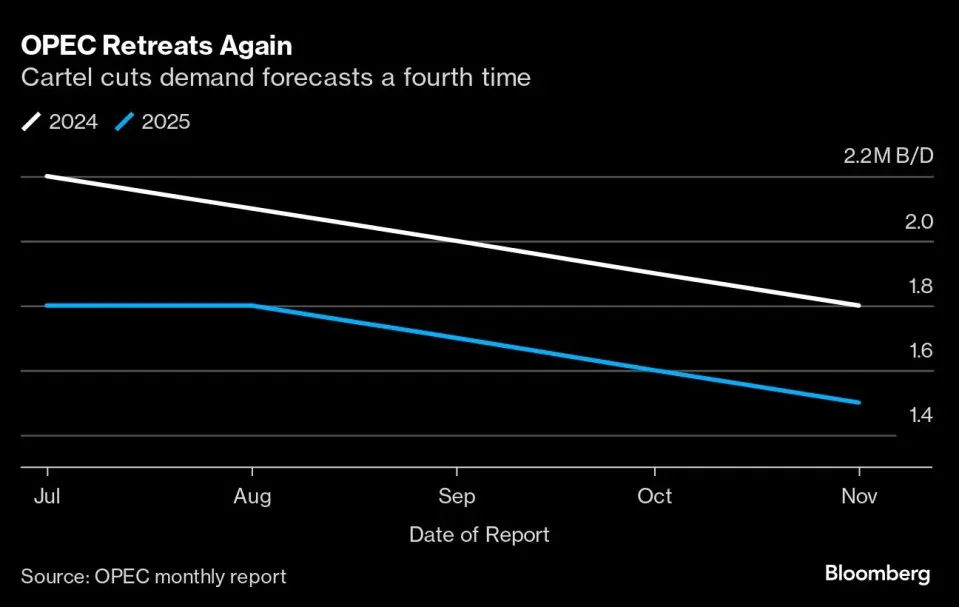
Global Oil Demand Slows as OPEC Cuts Forecast for the Fourth Time
OPEC’s Fourth Consecutive Cut Reflects China’s Economic Slowdown and Global Demand Shifts

The Organization of Petroleum Exporting Countries (OPEC) has reduced its forecast for oil demand growth for the fourth consecutive month, reflecting a sharp adjustment in response to slower-than-expected economic activity in major consumer markets like China. In its monthly report, OPEC now projects a growth in global oil consumption of 1.8 million barrels per day (bpd) in 2024—about 107,000 bpd less than previous estimates.
This adjustment marks a nearly 20% reduction in demand growth projections since July. Nonetheless, OPEC’s outlook remains more optimistic than other major forecasts, including those from the International Energy Agency (IEA), Wall Street firms, and even Saudi Arabia’s state oil company, Aramco.
Why OPEC is Cutting Demand Forecasts
A key driver behind OPEC’s revised demand projections is the economic slowdown in China, the world’s largest oil consumer. A mix of slower manufacturing, property market challenges, and weakened consumer demand has led to consecutive months of lower oil consumption in the country.
In addition to China, other Asian markets such as India are experiencing slower-than-expected growth. This trend has forced OPEC to revise its expectations for demand recovery in these crucial regions.
Geopolitical Uncertainties Looming Over Oil Demand
The return of Donald Trump to the U.S. presidency could bring back tariffs on Chinese imports, potentially straining the economic relationship between the world’s two largest economies. Trade tensions could further dampen oil demand, especially if Trump’s policies result in lower economic activity in China.
While the Middle East has remained relatively calm, the region’s political landscape continues to be a key factor influencing global oil supply. The market’s optimism reflects the assumption of stability, but any escalation in the region could change the dynamic rapidly, impacting prices and OPEC’s production strategy.
How OPEC+ Members are Adapting Production
Saudi Arabia, as OPEC’s largest producer and leader, has been instrumental in moderating supply to match the revised demand forecasts. It has delayed production increases, initially planned for this year, into 2024 to prevent further pressure on oil prices.
Kazakhstan and Iraq have taken steps toward compliance with OPEC’s production targets. Kazakhstan’s reduction in output by 292,000 bpd aligns with its OPEC commitments, reflecting both adherence to quotas and maintenance adjustments. Iraq, which has traditionally struggled to meet production targets, has reduced its output to move closer to compliance.
The Drop in Oil Prices and Global Market Impact
International crude futures have dropped by roughly 18% since July, trading near $72 a barrel in London. This decline is partially due to growing confidence that supply from the Middle East will remain stable, along with concerns about slowing demand from Asia. The price drop has led traders to focus on the effects of weakened demand rather than the potential for supply disruptions.
OPEC’s Diverging Outlook from the International Energy Agency
The IEA, OPEC’s primary forecasting rival, remains more cautious about oil demand growth, largely due to the rise of electric vehicles and other sustainable technologies that could reduce oil dependency in the coming years. This divergence signals a potential challenge for OPEC in aligning its production strategy with shifting global energy consumption patterns.
Conclusion: The Road Ahead for OPEC and Global Oil Markets
OPEC’s downward revisions to demand growth reflect a growing awareness of economic headwinds in key markets, as well as potential shifts in U.S.-China trade relations. As OPEC+ prepares to meet on December 1, it faces the challenge of balancing production levels with an increasingly complex demand outlook, setting the stage for a pivotal year in oil markets.