
Could Canada’s First Natural Hydrogen Discovery Be the Savior of Clean AI Computing?
Exploring how an unprecedented partnership between a natural hydrogen explorer and seasoned transmission developers aims to solve artificial intelligence’s biggest bottleneck—clean, dedicated baseload power.
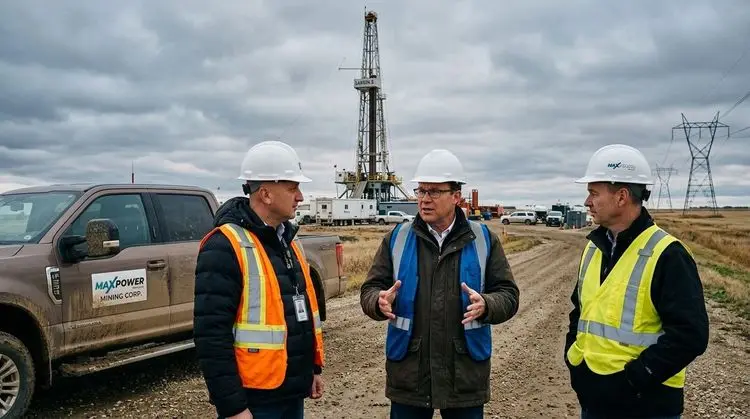
Tapping into an unmapped energy source deep beneath the Canadian plains is an audacious technical pursuit, but coaxing naturally occurring hydrogen molecules out of deep basement rock and straight into the power-hungry racks of artificial intelligence servers is an entirely different level of ambition.
MAX Power Mining Corp. (CSE: MAXX; OTC: MAXXF) is setting out to bridge that formidable gap. The exploration outfit has entered into a strategic Memorandum of Understanding with Douglas Capital Inc. to evaluate dedicated, natural hydrogen-fueled power generation for domestic AI data centers while simultaneously expanding its footprint across Saskatchewan’s emerging Genesis Trend.
The collaboration pairs exploration geology with heavy-hitting power development pedigree. Douglas Capital Inc. is spearheaded by John Douglas, an infrastructure veteran who previously founded Transmission Developers Inc. and originated the C$8 billion, 1,250-megawatt Champlain Hudson Power Express, which recently began channeling Québec hydroelectricity straight into New York City. Alongside partner Dr. Denis Steyn, an electrical engineer and former Siemens high-voltage executive who also heads power electronics firm Verdyn Inc., the team has already financed and operated industrial generation through Public Energy Inc. and completed engineering designs for hydrogen power plants under Current H2 Inc..
Under the framework, the two groups have given themselves 30 days to hammer out a joint feasibility work plan. The mandate centers on two parallel tracks. Locally, the partnership plans to assess modular, Canadian-engineered data centers across Saskatchewan designed to consume baseload power fired directly by naturally occurring hydrogen. On a macro scale, the initiative explores offloading bulk clean power into the CANVergence Energy Way, an ambitious 2,000-megawatt multi-terminal high-voltage direct current corridor proposed to run from Alberta to Ontario under total First Nations ownership and control.
While commercial blueprints take shape in boardroom presentations, field crews are pushing the drill bit further into the Western Canadian Sedimentary Basin. MAX Power Mining confirmed that its Lawson 5 step-out well, drilled to a total depth of 2,175 meters roughly 30 kilometers from the original Lawson discovery, successfully cased an active, generative natural hydrogen system along the western perimeter of the Prairie Evaporite salt basin. Core samples pulled from the Precambrian basement and lowermost Deadwood Formation revealed intensive serpentinization, hematite oxidation, and iron redox reactions, the signature chemical engine rooms of subsurface hydrogen generation. Lawson 5 also intercepted prospective helium intervals in the overlying Lower Interlake formation, adding a high-value industrial byproduct to the mix.
Rather than resting on the core barrels of Lawson 5, the drilling rig immediately mobilized eight kilometers to the southeast to spud Lawson 6, positioned to drill straight through the Prairie Evaporite salt seal. With active systems now verified across three distinct project hubs stretching 365 kilometers from the edge of the salt formation down to the Bracken target near the United States border, the company is attempting to prove that Lawson is not an isolated geological anomaly, but an extensive regional basin.
The pivot toward flow and deliverability has officially begun. A completion program is actively underway at Bracken, with service crews scheduled to head north immediately afterward to run testing at the Lawson Complex, comprising Lawson 1 through 4. For institutional watchers, these upcoming flow rates, reservoir pressure metrics, and gas concentration numbers represent the ultimate litmus test separating speculative mud-gas anomalies from an economically viable primary energy commodity.
To fund its aggressive timeline, MAX Power Mining bolstered its treasury by $1.662 million CAD through the exercise of warrants and stock options between September 1 and mid-October. Corporate infrastructure is tightening as well, with the company retaining investment banking firm Hampton Securities Limited under a $400,000 CAD advisory agreement and broadening its investor outreach through marketing contracts with RazorPitch, Inc. and Emerging Markets Consulting, LLC.
Executives from MAX Power Mining Corp. (CSE: MAXX; OTC: MAXXF) are presenting to institutional allocators at the Planet MicroCap Showcase and the Red Cloud Fall Mining Showcase in Toronto before flying to Paris for the H-NAT global natural hydrogen summit. If the drill core chemistry and high-voltage transmission plans hold together under real-world testing, Saskatchewan may find itself providing both the computational power and the clean electrons fueling North America's next industrial wave.
Sources
- GlobeNewswire: "MAX Power Partners With Douglas Capital to Advance Natural Hydrogen-Powered AI Data Centers and Canadian Energy Infrastructure," published on October 27, 2026. Available on SEDAR+ under MAX Power Mining Corp. continuous disclosure filings.
- GlobeNewswire: "Max Power Expands Scale of Saskatchewan Natural Hydrogen System With Lawson 5, Commences Follow-Up Well," published on October 27, 2026. Available on SEDAR+ under MAX Power Mining Corp. continuous disclosure filings.
Disclaimer
Neither the author of this article nor JuniorStocks (juniorstocks.com) holds equity, stock options, or any direct or indirect financial positions in MAX Power Mining Corp. (CSE: MAXX; OTC: MAXXF; FSE: 89N) or any other entities referenced in this publication. This content is published strictly for informational, educational, and journalistic purposes, was prepared independently without cash or equity compensation from the profiled issuers, and utilized artificial intelligence assistance for editorial research, drafting, formatting and image generation.
Early-stage natural resource exploration and emerging sectors, including subsurface natural hydrogen along Saskatchewan’s Genesis Trend, involve significant technical, commercial, environmental, and financial risks. Statements regarding geological potential, future flow rates, drilling targets, or commercial partnerships are inherently forward-looking and subject to substantial uncertainties.
This publication does not constitute an endorsement, investment recommendation, legal guidance, or financial advice, nor is it a solicitation to buy or sell any security. Junior resource equities carry high volatility and the potential for a total loss of invested capital. Readers are strongly urged to conduct independent due diligence, review official continuous disclosure documents on SEDAR+ (sedarplus.ca), and consult with a certified, registered financial advisor before executing any investment transactions.