
Core Lithium's Mining Halts Amid Market Turmoil
Core Lithium's Bold Move: Navigating Turbulent Waters in the Lithium Market
Australia's Core Lithium (ASX: CXO) is grappling with challenging market conditions as it suspends mining operations at its Finniss site. This article delves into the factors leading to this decision and the broader implications for the lithium industry.
Market Review
The lithium market has faced unprecedented challenges, with prices plummeting from approximately $8000 per tonne a year ago to a meager $950 per tonne. This sharp decline has sent shockwaves across the industry.
Core Lithium's Operations Review
In response to the adverse market conditions, Core Lithium initiated a comprehensive review of its operations in December. This review led to the suspension of early works on the proposed second mine, BP33, as the company assessed the feasibility of continuing under such tough circumstances.
The suspension of the BP33 project was a significant decision for Core Lithium, reflecting the severity of the challenges faced by lithium producers in the current market.
Core Lithium's Grants open pit mine, part of the multi-mine Finnis hard-rock lithium complex, became operational in October 2022. It marked the initiation of production and the sale of spodumene concentrate in February 2023.
In a strategic move, Core Lithium revealed that it has approximately 280,000 tonnes of ore stockpiled. This stockpile is expected to sustain the processing plant's operations until mid-2024 without requiring additional mining efforts.
Lithium Price Collapse
The collapse in Lithium Prices has been staggering, with spodumene concentrate now trading at a fraction of its value a year ago. This abrupt decline has caught the industry off guard.
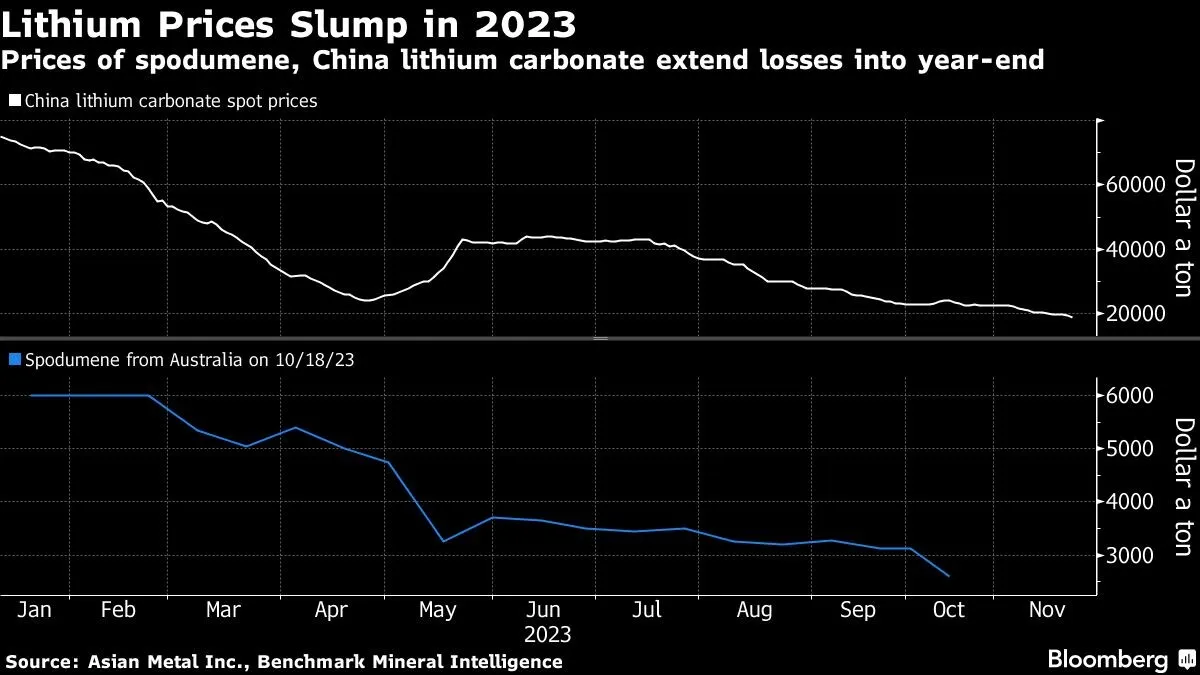
Industry experts anticipate further price drops, particularly in China, where lithium carbonate prices are projected to decrease by more than 30% in 2024 compared to December 2023 levels. This trend is attributed to an oversupply of lithium, surpassing the demand from battery manufacturers.
High-cost lithium producers are expected to bear the brunt of the price rout initially. The implications of this price slump may ripple through the industry, affecting even the world's top mining companies specializing in battery metals.
UBS, a leading financial institution, predicts a substantial 40% increase in global lithium supply in 2024, reaching more than 1.4 million tons of lithium carbonate equivalent. This surge in supply is driven by various factors across different regions.
Australia and Latin America are expected to witness a 22% and 29% increase in lithium production, respectively, according to UBS. Africa is poised for a doubling of production, fueled by projects in Zimbabwe.
China is not exempt from the lithium production surge, with a projected 40% increase in the next two years. A significant catalyst for this surge is the CATL project in southern Jiangxi province.
As a result of the challenging market conditions and the anticipated price decline, UBS warns that ASX lithium companies might see their profits halved by FY2025.
In conclusion, Core Lithium's decision to halt mining operations at Finniss reflects the harsh realities of the current lithium market. The industry's future remains uncertain, with a looming oversupply threatening prices and profits.