
Biden Administration's Nuclear Energy Push Energizes Uranium Sector
Uranium Market Revival: A Resilient Surge Amidst Global Energy Transition

In response to the US government's announcement of soliciting bids to boost domestic production of nuclear fuel for enhanced national energy security, uranium miners worldwide are experiencing a surge in their stock values. The US Department of Energy has formally invited proposals from American companies to engage in the production of high-assay low-enriched uranium, commonly referred to as HALEU. This move signals the government's intent to invest up to $500 million in projects aimed at transforming HALEU into chemical precursors for nuclear fuels.
The Impact on North American Uranium Miners
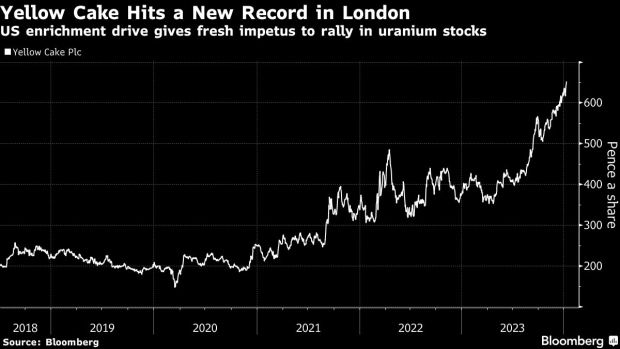
The news has had an immediate and positive effect on North American uranium miners, particularly companies like Global Atomic Corp. and NexGen Energy Ltd., whose stock prices witnessed a significant uptick following the announcement. The reaction was not limited to the North American continent, as Australian peers, including Paladin Energy Ltd. and Deep Yellow Ltd., also experienced substantial gains, driven by the anticipation of higher Uranium Prices. Uranium investment firm Yellow Cake Plc soared to record heights when the London trading session opened, building upon last year's remarkable 65% increase.
Biden Administration's Enrichment Initiative
The Biden administration's commitment to ramping up uranium enrichment is gaining momentum, particularly in light of recent legislative developments. The US House of Representatives has approved a bill aimed at restricting enriched-uranium imports from Russia, the nation's primary foreign supplier of such fuel. Although the bill's progress has faced delays in the Senate and would only take effect later in this decade if enacted into law, it has already breathed new life into uranium prices.
In a recent report, Bloomberg highlighted that Tenex, a Russian state-owned uranium company, had cautioned its American customers about the possibility of Russia preemptively halting nuclear fuel exports if the US legislation passed. Rosatom, the parent company of Tenex, denied these allegations.
Futures and the Yellowcake Resurgence
Futures related to the spot prices of yellowcake, a raw form of uranium, reached their highest point in 15 years on a Tuesday that marked a significant turning point. Over the course of the previous year, these futures more than doubled in value. This remarkable surge can be attributed to Western initiatives aimed at bolstering energy security and reducing emissions, sparking a global resurgence of interest in nuclear power.
John Ciampaglia, CEO of Sprott Asset Management, commented on this development, stating, "The global pivot back to nuclear energy creates opportunities and challenges. We need to rebuild supply chains that have long since disappeared."
Challenges and Prospects for Smaller Reactors
While the resurgence in nuclear energy is undeniable, it is essential to acknowledge the challenges that prospective producers are facing. Rising development costs have placed many in a precarious position. For instance, NuScale Power Corp., the first company to receive US approval for a small nuclear reactor design, had to cancel its plans to construct a power plant in November. Furthermore, it was forced to lay off more than a quarter of its workforce this month.
One of the promises associated with smaller reactors is their supposed ease of construction, which is intended to limit cost overruns and delays—issues that have historically plagued the development of conventional large-scale reactors. However, a colossal new nuclear plant operated by Southern Co. in Georgia only entered service in July, seven years behind schedule and with a budget that ballooned to over $30 billion.
In conclusion, the US government's initiative to bolster domestic production of nuclear fuel has breathed new life into uranium miners and the broader nuclear energy sector. While the surge in interest presents opportunities, it also comes with significant challenges, particularly concerning the cost-effectiveness of smaller reactors. As the world navigates the evolving landscape of nuclear energy, it must strike a delicate balance between supply chain rebuilding and prudent financial management.