
A Hot Debate: India's Plans to Double Coal Production
Navigating India's Energy Dilemma: The Complex Path of Coal Production and Climate Responsibility
India is at a critical crossroads as it grapples with the need to address its growing energy demands while facing the pressing climate crisis. Amidst discussions at COP28 in Dubai last December, where climate diplomats debated the urgency of transitioning away from fossil fuels, India stood at a pivotal moment. The Indian government announced its intention to double coal production by 2030, aiming to reach a staggering 1.5 billion tons. Simultaneously, they unveiled plans to add 88 gigawatts of thermal power plants by 2032, with coal playing a predominant role in this expansion.
A Counterintuitive Move
This decision to invest heavily in coal, one of the major contributors to global warming, may seem counterintuitive for a country like India, which is exceptionally vulnerable to the impacts of climate change. However, it is driven by a complex set of circumstances, primarily the need to avoid power shortages as India heads into elections in April and May. India has experienced record-breaking heatwaves and surges in peak electricity demand over the past two years.
The Balancing Act
Prime Minister Narendra Modi's approach seems to be a delicate balancing act, advocating for both renewable energy sources and coal-based power generation. The rationale behind this approach, as explained by Sandeep Pai, director of the climate-focused organization Swaniti Global, is a sharp increase in the demand for electricity.
Challenges in Renewable Energy
Despite India's ambitious goal of achieving 500 gigawatts of clean-energy capacity by 2030, the country faces significant challenges in scaling up its renewable energy infrastructure. BloombergNEF reports that the rate of installation of solar and wind power falls far short of what is required.
Factors Impeding Renewable Energy Growth
Several factors hinder the growth of renewables. Rohit Gadre of BNEF cites misaligned incentives among state-owned electricity retailers, land acquisition difficulties, and inconsistent policies at federal and state levels as primary obstacles. These challenges deter private investors from accelerating renewable energy projects, despite the surging demand for power.
Coal's Uphill Battle
Coal, on the other hand, faces its own set of challenges in attracting new investments. Vibhuti Garg, South Asia director for the Institute for Energy Economics and Financial Analysis, explains that coal power plants take longer to construct and entail higher costs compared to solar and wind power installations.
Realistic Coal Targets
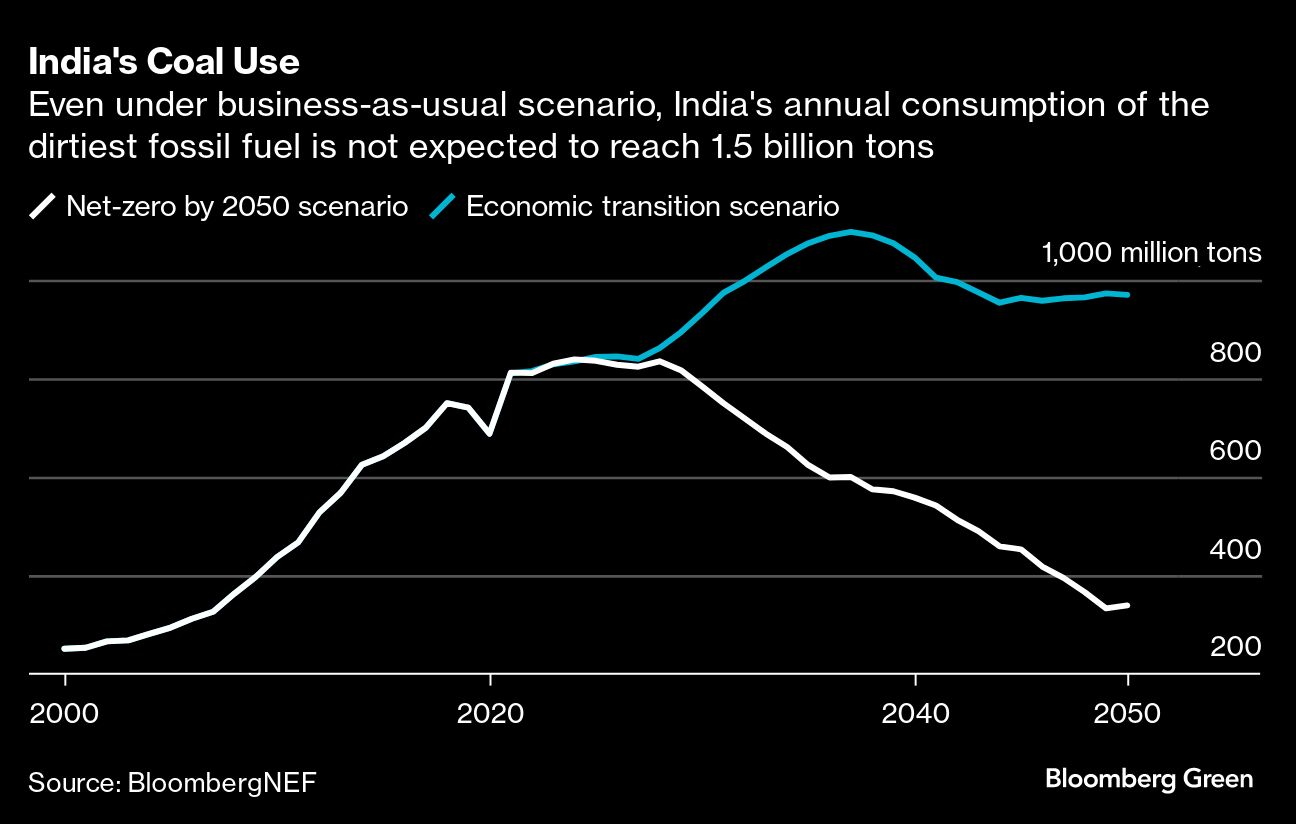
Experts like Pai and Gadre do not foresee India reaching the ambitious coal production targets it has set. BloombergNEF's economic-transition scenario predicts that India's coal consumption will peak at 1.1 billion tons before 2040.
Investment Needs
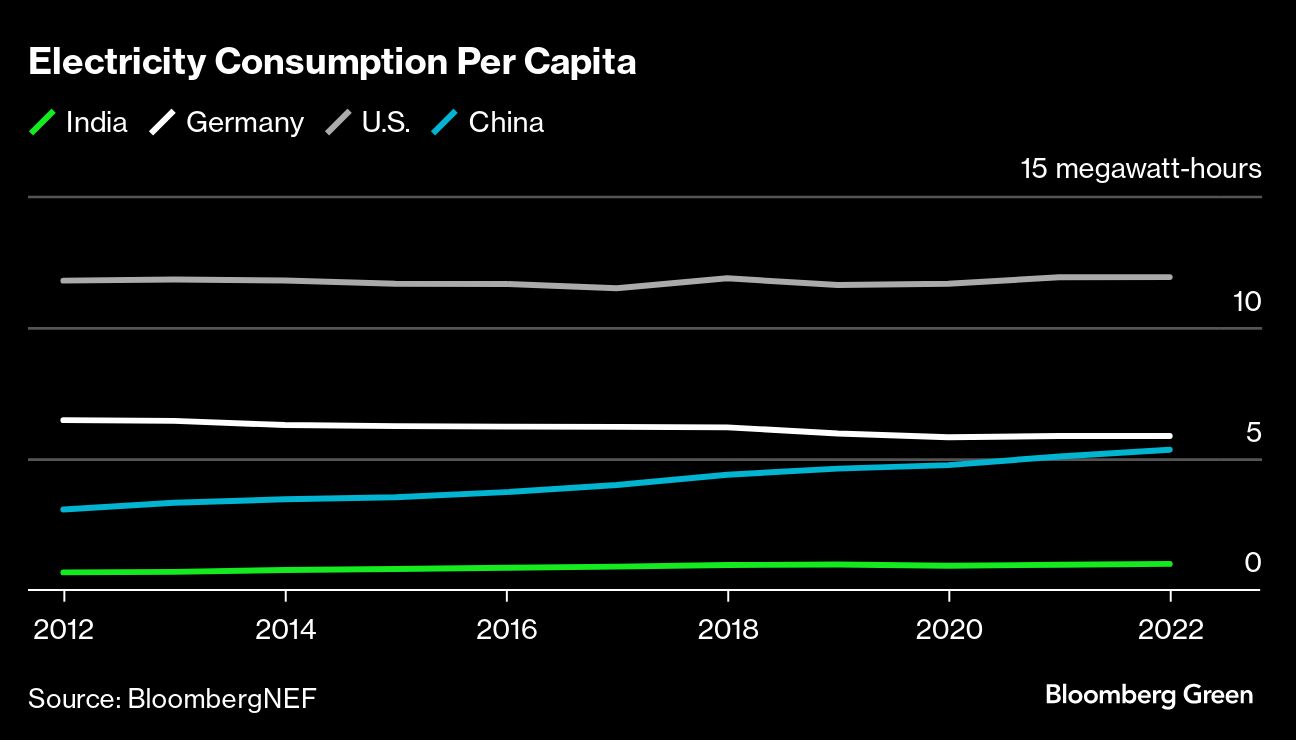
India urgently requires investment in its energy infrastructure as it strives for economic growth. The per capita electricity consumption in India remains significantly lower than that of developed countries and even China. Moreover, India has not yet utilized its fair share of the global carbon budget.
International Cooperation
India, alongside other developing nations, requires more substantial incentives to choose a greener path. While the Group of Seven nations have initiated the Just Energy Transition Partnership in an effort to reduce coal use in countries like South Africa, Vietnam, and Indonesia, these efforts have faced challenges and yielded limited results.
The Call for Global Support
Despite the global consensus on transitioning away from fossil fuels, India's environment minister Bhupendra Yadav emphasized that effective solutions to help countries like India replace coal remain elusive. Rich countries must not only provide financial support but also offer better policies, technology transfer, and skills training.
Conclusion
India stands at a crucial juncture, torn between its soaring energy demands and the pressing need to combat climate change. While doubling coal production appears to be a counterintuitive move, it reflects the intricate challenges and political dynamics of the nation. As the world seeks to transition away from fossil fuels, it is imperative to offer meaningful support and solutions to developing countries like India, ensuring a sustainable and greener future for all.