
16 Days of War, 5 Years to Reload: The $26 Billion Defense Supply Crisis
As $26B in precision munitions vanishes in 16 days, warfare exposes severe defense supply chain chokepoints, shifting investor focus to junior critical mineral miners, synthetic propellant innovators, and next-gen counter-drone tech.
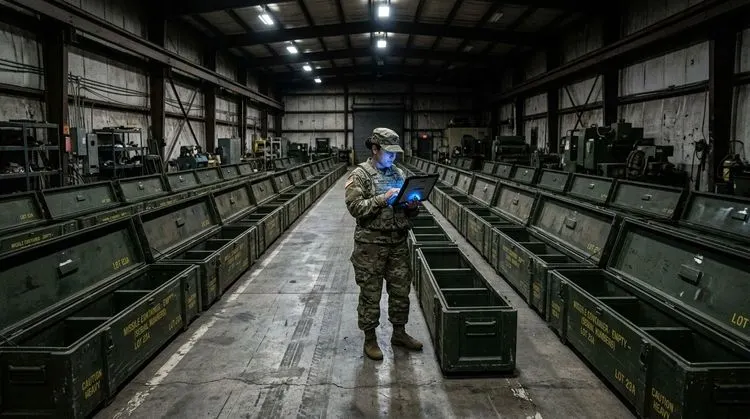
Sixteen days of high-intensity operational activity in the Middle East have delivered a brutal awakening to Western defense strategists: fancy battlefield dominance counts for nothing if factory floors cannot reload the launchers. During the initial fortnight of Operation Epic Fury, coalition forces consumed 11,294 precision munitions at a staggering direct cost of $26 billion. As highlighted in a groundbreaking analysis by Macdonald Amoah, Morgan D. Bazilian, and Lieutenant Colonel Jahara Matisek published by the Royal United Services Institute (RUSI), this burn rate exposes a critical vulnerability. Multi-million-dollar interceptors are regularly spent neutralizing low-cost drones and decoys, an operational imbalance that left Ukrainian military advisors on the ground astonished by coalition air defenses "firing thoughtlessly" into incoming salvos.
Following an opening salvo exceeding 5,000 munitions in the first 96 hours, the war entered a grinding trial of attrition. Even with Iranian strikes settling to an average of 33 missiles and 94 drones per day, coalition arsenals are depleting at an alarming rate. Israeli stocks of Arrow interceptors face complete exhaustion within weeks, while American inventories of THAAD interceptors and ATACMS/PrSM missiles sit about a month away from dry bins. Replacing the more than 500 Tomahawk cruise missiles already fired will take at least five years under current manufacturing constraints. The global scope of this shortfall was underscored by Rheinmetall (ETR: RHM) CEO Armin Papperger, who warned that Western stockpiles are virtually empty and continuing the war another month could leave forces with almost no missiles available.
Despite high-level meetings between government officials and industry leadership, production surges remain stalled because funded, binding contracts have not been issued. Major prime contractors like Lockheed Martin (NYSE: LMT), RTX Corporation (NYSE: RTX), and General Dynamics (NYSE: GD) are held hostage by long qualification cycles and sub-tier supply vulnerabilities. Crucial single-point production facilities, such as the Holston Army Ammunition Plant for high explosives, have yet to receive formal surge orders. This supply chain logjam is forcing an abrupt transition away from decades of fragile, "Just-in-Time" defense logistics toward an aggressive "Just-in-Case" strategy focused on sovereign equity injections, mandatory stockpiling, and onshore reshoring. With wartime production premiums expected to push total replacement costs past $50 billion, speed has suddenly become the most expensive component in military acquisition.
The operational crisis extends far beyond assembly lines directly into raw material bottlenecks, particularly as China continues tightening export restrictions on tungsten, antimony, gallium, and germanium. These chokepoints, paired with regional shipping threats caused by the closure of the Strait of Hormuz, are turning junior mining developers holding allied deposits into indispensable national security assets. Developers like Perpetua Resources Corp. (Nasdaq: PPTA) are receiving federal backing to unlock domestic antimony reserves for munitions, while MP Materials Corp. (NYSE: MP) and Energy Fuels Inc. (NYSE American: UUUU) anchor Western rare earth and critical mineral processing. In tungsten, a critical input for armor-piercing rounds and point-defense systems, junior producers like Almonty Industries Inc. (TSX: AII) are strategically positioned as Western militaries scramble to bypass foreign supply chains.
Sustaining defense requires addressing the ruinous cost exchange ratio through "cheap defeat" mechanisms. Over the first 16 days, C-RAM gun systems fired approximately 509,500 rounds costing around $25 million, compared to $19 billion spent on missile interceptors. However, gun ammunition relies on the same propellant facilities at Radford and Holston, and consumes thousands of kilograms of tungsten, competing directly upstream with Tomahawk and Patriot missile lines. To break this energetic coupling trap, defense capital is flowing toward junior hardware innovators and next-generation counter-drone developers. Emerging defense hardware providers like Anduril and Epirus, along with developers of high-energy lasers, directed microwave systems, and modular sensor frameworks, are pioneering composable air defense architectures designed to absorb massed drone swarms without draining high-end interceptor stocks.
With Iran damaging at least a dozen allied radar arrays and satellite terminals, engagement efficiency has plummeted, forcing air defenses to expend as many as 8 to 11 interceptors to defeat a single threat. Sub-tier fabricators specializing in Gallium Nitride (GaN) semiconductors, microwave integrated circuits, and replacement optical sensors face massive backlogs as militaries race to rebuild degraded radar networks. Ultimately, every missile fired in the Middle East levies a heavy "second-theatre tax," eroding Western deterrence in secondary operational zones like Taiwan and Ukraine. Victory in high-intensity modern warfare no longer belongs to the side with the most impressive initial power projection, the old "Command of the Commons", but to whichever nation masters the "Command of the Reload" through a resilient, scalable, and domestically anchored industrial economy.
Source
- Amoah, Macdonald, Morgan D. Bazilian, and Lieutenant Colonel Jahara Matisek. "Over 11,000 munitions in 16 Days of the Iran War: 'Command of the Reload' Governs Endurance." Royal United Services Institute (RUSI) / Payne Institute for Public Policy, 24 March 2026.
Disclaimer
Neither the author of this article nor JuniorStocks.com holds equity, stock options, short positions, or any other financial positions in Rheinmetall AG (ETR: RHM), Lockheed Martin Corporation (NYSE: LMT), RTX Corporation (NYSE: RTX), General Dynamics Corporation (NYSE: GD), Perpetua Resources Corp. (Nasdaq: PPTA), MP Materials Corp. (NYSE: MP), Energy Fuels Inc. (NYSE American: UUUU), Almonty Industries Inc. (TSX: AII), or any other companies mentioned in this publication. This content is published by JuniorStocks.com strictly for informational purposes, was prepared independently without company compensation, and utilized AI assistance for text editing, formatting, and generating accompanying media. While defense supply chain chokepoints and junior critical mineral developments represent compelling macroeconomic trends, this article does not constitute investment or financial advice. Investors are strongly advised to conduct their own thorough, independent due diligence and consult with a qualified financial professional before making any investment decisions.