
UnitedHealth’s Emergency Room Exit, Courtesy of Buffett
Buffett’s bold bet revives UnitedHealth’s stock and reshapes the narrative around the Dow’s worst performer of 2025.
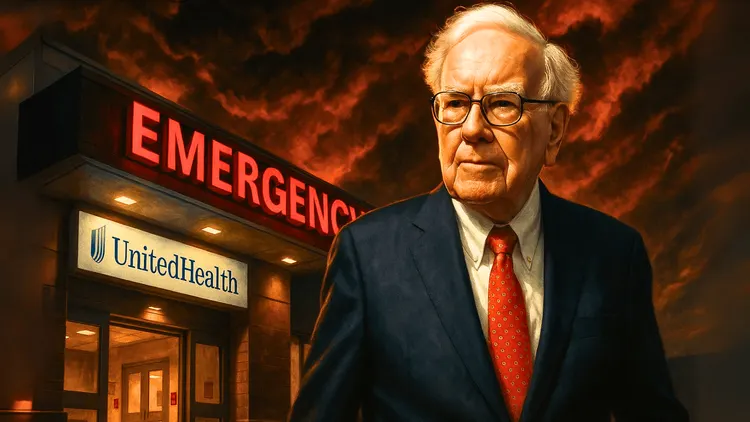
UnitedHealth Group stunned Wall Street on Friday, surging more than nine percent after Warren Buffett’s Berkshire Hathaway disclosed a significant stake in the embattled health insurance giant. The move, a classic Buffett play, sent a wave of optimism through a market that had all but written off the stock as one of this year’s biggest blue-chip disappointments.
The Minnesota-based company has endured a bruising two years. Spiraling costs, a federal investigation into its government-backed health plans, a devastating cyberattack that exposed the personal data of nearly 200 million Americans, and the shocking murder of its insurance division chief in December have rattled confidence. Two straight quarters of missed profit expectations compounded the pain, driving UnitedHealth’s shares down nearly 46 percent in 2025 — the worst performance on the Dow Jones Industrial Average.
Buffett’s Vote of Confidence
Berkshire Hathaway revealed it now owns 5.04 million UnitedHealth shares valued at roughly $1.57 billion as of June 30. The purchase marks Buffett’s return to a company he last held between 2006 and 2009, before selling in 2010. It’s a familiar pattern for the billionaire investor, who has made a career of betting big on companies under duress when he sees enduring value. His moves in Goldman Sachs during the 2008 financial crisis and Occidental Petroleum in 2019 are case studies in his contrarian approach.
Market watchers say the psychological impact of Buffett’s involvement is as significant as the capital itself. “Buffett’s purchase is a psychological reassurance to many investors that saw UnitedHealth as untouchable given the massive turbulence in the stock over the past few months,” said Kevin Gade, COO at UnitedHealth shareholder Bahl & Gaynor.
The Road Back
While the endorsement from Omaha has shifted sentiment, UnitedHealth’s leadership still faces a steep climb to restore trust. CEO Andrew Witty resigned abruptly in May under mounting operational and financial pressures. Former chief executive Stephen Hemsley, who successfully steered the company from 2006 to 2017, has returned to the helm to stabilize operations and investor relations.
Analysts remain cautious. In July, the company projected full-year adjusted earnings per share of at least $16 — far below the consensus estimate of $20.91, even after recent downward revisions. UnitedHealth’s forward price-to-earnings multiple now sits at about 15.8, well under its five-year average of 19, suggesting the market has priced in heavy skepticism about its recovery prospects.
Morningstar’s Julie Utterback believes the pessimism may be overdone. “While UnitedHealth still faces elevated uncertainty, it is good to see that this renowned investment firm also believes the market is discounting assumptions that are too pessimistic for the long term,” she said.
A Ripple Across the Sector
Buffett’s move didn’t just lift UnitedHealth. Shares of rival insurers Centene, Humana, and Molina Healthcare also gained between two and four percent, reflecting renewed confidence in the sector’s resilience. Other Berkshire disclosures revealed new positions in steelmaker Nucor, security products provider Allegion, and outdoor advertising firm Lamar Advertising — a reminder that Buffett’s influence extends far beyond a single trade.
For UnitedHealth, the challenge now is turning this momentum into a sustained recovery. With the return of a familiar leader, the backing of one of the world’s most respected investors, and a share price still far from its historical highs, the stage is set for one of the most closely watched turnarounds in corporate America.