
Uber Invests $300M in Lucid to Spark Robotaxi Rollout
Lucid, Nuro, and Uber team up in a $300 million deal to unleash a new wave of autonomous EVs on U.S. roads starting in 2026
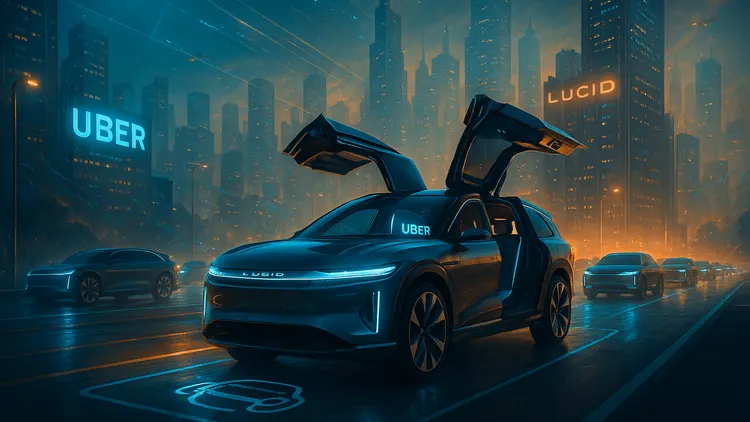
Uber is injecting $300 million into Lucid Motors as part of a high-stakes robotaxi collaboration. The ride-hailing giant is partnering with Lucid and autonomous tech firm Nuro to unleash a fleet of over 20,000 self-driving Lucid Gravity SUVs, signaling its full-throttle return to the driverless race after years on the sidelines.
This isn’t just another tech partnership. It’s a major play that pits Uber against industry titans like Tesla, <a class="tvreplink" target="_blank" href="https://www.tradingview.com/chart/?symbol=Nasdaq%3AGOOG">Alphabet’s Waymo, and Amazon’s Zoox in a new phase of the robotaxi war. Beginning in 2026, Lucid's futuristic Gravity SUVs will hit the streets of a major U.S. city, armed with Nuro’s self-driving systems and fully integrated into Uber’s platform. The companies didn’t disclose the first launch city, but all eyes are on Las Vegas or Los Angeles, both AV hotspots.
Lucid’s stock surged more than 56 percent in pre-market trading, a reaction not just to the Uber partnership but also to the company’s proposed one-for-ten reverse stock split. Investors are reading this move as Lucid getting serious about its long-term viability, shedding some of the baggage that’s weighed on the EV start-up in recent months. A reverse split could help keep Lucid’s listing compliant with Nasdaq requirements, while the Uber deal gives it a much-needed narrative of scale and relevance.
Uber’s re-entry into the AV scene is equally significant. After selling off its self-driving unit in 2020, the company shifted to a partnership model, aligning with tech-first firms like Waymo and Aurora. This Lucid-Nuro collaboration, however, takes things a step further. Uber isn’t just testing someone else’s tech, it’s investing capital, resources, and reputation in a fleet of robotaxis built from the ground up with its platform in mind. That’s a strategic evolution.
The robotaxi field has been marred by hype, slow regulatory movement, and technical failures. Cruise, GM’s autonomous arm, recently hit the brakes following safety concerns and regulatory scrutiny. Meanwhile, Waymo is cautiously expanding and Tesla’s limited rollout in Austin is still tightly managed. In contrast, Uber’s Lucid-Nuro approach offers a clean slate and, perhaps, a smarter rollout strategy that balances ambition with infrastructure.
At the heart of this deal is Nuro, the autonomous tech provider co-founded by former Waymo engineers. Known initially for its small, delivery-focused bots, Nuro is now stepping into full-scale passenger mobility. Its “Nuro Driver” system is being groomed to fit seamlessly into Lucid’s large electric SUVs. A prototype of the Lucid-Nuro vehicle is already operating autonomously on Nuro’s test track in Las Vegas, and the company is confident about meeting regulatory milestones. While it still requires additional state-level licensing, Nuro’s track record gives it a leg up.
What makes this deal even more compelling is the way it triangulates investment and expertise. Lucid brings EV credibility and manufacturing muscle. Nuro delivers the brains of the operation through its self-driving software. Uber brings the global platform, logistics engine, and market access that’s critical for mass adoption. It’s not a simple vendor relationship, it’s a triangle of interdependent capabilities.
Lucid’s interim CEO Marc Winterhoff said the partnership marks a new chapter for the company. “We’re expanding beyond our traditional EV technology leadership and into areas we’ve never really focused on,” he told Reuters. For Lucid, this isn’t just a deal to offload some inventory. It’s an entry ticket into the autonomous mobility race, one of the few future-facing trends that still promises exponential growth.
Nuro co-founder Dave Ferguson added that his team is in “very active conversations” with other automakers looking to embed the Nuro Driver in personal vehicles. It’s a hint that what’s being launched with Lucid and Uber is only the beginning of a much bigger deployment strategy.
Uber’s parallel deal with Volkswagen’s ID.Buzz, announced in April, reinforces the company’s diversified approach. No longer banking on a single partner or platform, Uber is hedging smartly across multiple technologies and vehicle formats. But the Lucid agreement feels different, more integrated, more deliberate.
The AV dream has suffered from inflated timelines and disappointing rollouts, but this deal brings together three firms that have something to prove and the runway to do it. If Lucid can execute on the manufacturing side, if Nuro can navigate regulatory headwinds, and if Uber can integrate the tech into its massive user base without a hitch, we might finally see a robotaxi fleet that lives up to the promise.
The stakes are high. Success would mean Uber leads the AV race not by building everything in-house but by orchestrating the right partners. Failure, on the other hand, would be yet another billion-dollar lesson in the perils of over-promising tech.
One thing is clear. After years of setbacks and skepticism, the race for robotaxis just got a major jolt of credibility. And the road ahead is about to get a lot more crowded.
Conclusion
Uber’s $300 million investment in Lucid marks a pivotal moment in the race toward autonomous mobility. With Lucid’s high-tech Gravity SUVs, Nuro’s proven AV platform, and Uber’s unmatched distribution network, the partnership has the potential to redefine urban transport. After years of missed timelines and broken promises, this move feels grounded, strategic, and built for scale. It’s not just a press release. It’s a real step toward a future where cars drive themselves, and Uber rides come without a driver behind the wheel.