
The Latte Learns You: Starbucks’ AI Barista Is Always One Sip Ahead
How Brian Niccol’s Starbucks is brewing a bold new era where AI predicts your latte, remodels your café, and revives the “third place” experience.
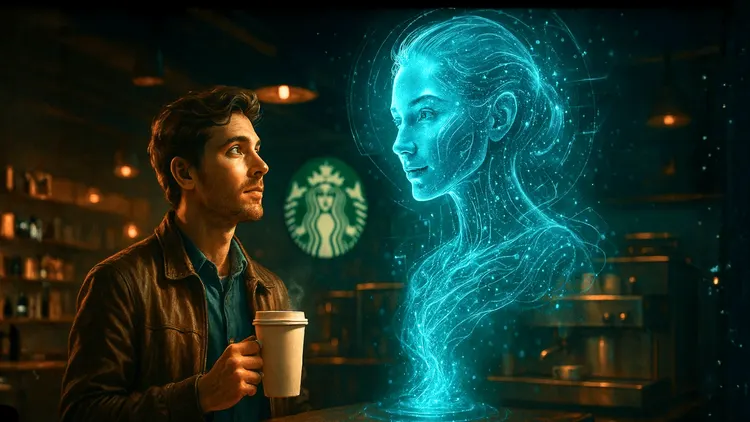
When Brian Niccol, Starbucks’ CEO, walked onto the stage at Salesforce’s Dreamforce event in San Francisco, the crowd expected talk of coffee, culture, and maybe the company’s new protein lattes. What they got instead was a glimpse into the future of retail, a future where artificial intelligence doesn’t just assist the barista — it becomes one.
In a conversation with Yahoo Finance’s Brian Sozzi, Niccol peeled back the lid on a quietly brewing revolution inside Starbucks: a secret AI-powered barista assistant known internally as “Green Dot.” Designed to predict customer orders and streamline operations behind the counter, this digital brain represents the company’s next big bet — one that could redefine the world’s largest coffee chain from the inside out.
A Year of Reinvention
Niccol, who took the reins of Starbucks in 2023, didn’t walk into a cozy café of contentment. He inherited a complex, global enterprise facing rising costs, digital strain, and a consumer slowdown that left even loyal latte drinkers thinking twice before tapping “order.” In his first year, the former Chipotle chief has been on a mission to re-caffeinate the brand. Over a thousand stores are being remodeled, underperforming locations shuttered, and the menu overhauled with trendy additions like protein-infused coffee and “craft energy” drinks.
“We’re going back to being a great customer service company,” Niccol told Sozzi. “It’s about bringing back the human connection, the personalization, the craft.”
But it’s the quiet work behind the scenes — the digital reengineering of how Starbucks runs — that might be his boldest move yet.
The Rise of the AI Barista
At the heart of Starbucks’ technological push lies “Green Dot,” an AI-driven assistant that helps store managers and baristas handle everything from drink prep to troubleshooting equipment. Niccol describes it as “a fast way to get the right answer,” a digital co-worker that whispers the next best step before a human even asks for help.
The Green Dot project isn’t just a gimmick. It’s part of a wider transformation that includes AI-powered forecasting, smarter inventory systems, and “Smart Queue” technology that prioritizes drink orders in real time. Imagine a system that can anticipate a morning rush, balance workloads across multiple access modes — drive-thru, delivery, counter, and mobile — and ensure your drink is ready the moment you step in. That’s the Starbucks Niccol envisions.
And yes, the AI is learning to remember you. Niccol hinted that the Starbucks app could soon use predictive intelligence to anticipate orders before you even open it. “You might just tell your phone, ‘I’ll be there in 10 minutes,’ and your drink will be ready,” he said. The idea sounds futuristic, but in a company that already runs one of the largest digital loyalty programs in the world, it’s not far-fetched.
A Balancing Act Between Robots and Humanity
The big question, of course, is whether AI will replace the human touch that made Starbucks what it is. Niccol was clear on that point: “We just put more partners back into our stores to give people a great experience. Not robotic. Real people, real craft.”
Starbucks isn’t chasing full automation. It’s chasing augmentation — using technology to make employees faster, smarter, and more focused on customers. The AI barista doesn’t pour the espresso, but it might make sure the machine never breaks down during the morning rush. It won’t hand you your latte, but it might tell your barista how to make it faster and better.
Niccol’s philosophy mirrors what’s happening across industries. AI isn’t replacing workers, it’s reshaping what they do. At Starbucks, that means freeing baristas from back-end chaos so they can deliver the “third place” experience — that sense of belonging between home and work — that the company built its empire on.
From Chipotle to Coffee: A Playbook for Turnaround
Before Starbucks, Niccol earned his reputation as the man who saved Chipotle from its E. coli crisis and turned it into a digital juggernaut. He introduced a disciplined innovation process known as “stage-gate,” where new menu items are tested, refined, and scaled based on feedback.
Now, he’s applying the same method to Starbucks. The protein latte — already a hit among health-conscious customers — started as a small pilot in five stores before rolling out nationwide. The idea is simple: learn fast, fix faster, scale only when perfect.
That approach is now seeping into every corner of the business. From menu design to supply chain logistics, Starbucks under Niccol is becoming a test kitchen for efficiency and experience. The AI barista is just the next iteration of that mindset.
Smart Stores, Smarter Customers
Walking into a remodeled Starbucks today feels subtly different. Digital order boards show your drink’s progress in real time. Mobile pickup zones are organized to reduce chaos. Behind the scenes, AI algorithms smooth out the traffic so that whether you order from your phone or through a drive-thru, your drink hits the counter in under four minutes.
Niccol calls this system “Smart Queue,” and it’s already quietly revolutionizing how the company handles volume. “We want to remove friction,” he said. “The more seamless we make it, the more customers feel the value.”
In a world where every second counts, Starbucks’ future may not lie in brewing faster — but in thinking faster.
Redefining the ‘Third Place’
Howard Schultz built Starbucks around the idea of a “third place” — not home, not work, but a communal haven. Critics say that model is outdated in a world glued to smartphones. Niccol disagrees.
He believes younger generations still crave spaces to gather, just differently. After-school crowds fill cafés again. Students lounge with laptops and protein drinks. Parents reconnect over matcha lattes. In his view, if Starbucks gets the atmosphere right — rugs, drapes, plants, and all — it can reclaim its role as a social anchor in a disconnected age.
“You need a couple of seats in every coffeehouse where people say, ‘That’s my spot,’” Niccol said with a grin.
The Price of a Premium Experience
Of course, that spot comes with a price tag. A Venti protein latte at JFK Airport now runs nearly $10, and Niccol isn’t apologizing. “We’re not trying to be promotional,” he said. “We’re craft, quality, experience. Affordable luxury.”
That phrase — “affordable luxury” — might be the new mantra for Starbucks. In an age where inflation has tightened wallets, the company’s challenge isn’t to be cheap but to be worth it. So far, Niccol claims value scores are climbing again, and customers are saying the experience feels premium enough to justify the cost.
Culture Shock and the Road Ahead
Behind all the glossy tech talk lies an equally important story: culture. Niccol’s first year has been about rebuilding Starbucks’ leadership team and reorienting thousands of employees toward one goal — service.
“It’s not easy to change culture,” he said. “You have to get the right people in the right jobs. Now it’s about driving execution.”
That mindset has carried him from mouthwash marketing at Procter & Gamble to running global restaurant empires. When asked whether his job at Starbucks is harder than his early days, Niccol laughed. “Both had a learning curve,” he said. “But I love the challenge. I love being part of a turnaround.”
The AI-Infused Future of Coffee
Starbucks’ AI ambitions don’t stop at the counter. Niccol is experimenting with AI across the corporate stack — from code generation to forecasting. “The ability to get code done faster is real,” he noted, describing how AI tools like ChatGPT are accelerating internal projects.
Ironically, the same technology powering Starbucks’ “Green Dot” assistant is also helping its CEO manage his own workflow. “There’s no better way to get context fast,” he said. “I used to search on Yahoo or Google. Now, I use AI.”
That loop — human using AI to build AI for humans — perfectly sums up where Starbucks stands today: at the intersection of craft and code, where the smell of espresso meets the hum of algorithms.
Conclusion
Starbucks has always sold more than coffee. It sells moments — the five-minute pause in a chaotic day, the friendly nod from a barista who remembers your name, the ritual that starts your morning. Under Brian Niccol, that ritual is being reimagined for an AI-driven world.
The company’s new “Green Dot” assistant, predictive ordering system, and tech-first culture aren’t about replacing the barista. They’re about elevating them — blending humanity with intelligence to make every cup faster, smoother, and more personal.
In Niccol’s Starbucks, your next drink might already be waiting before you even think to order it.