
Tesla's Market Value is “Insane,” Say Veteran Investors
Wall Street sounds the alarm as Tesla’s valuation soars beyond fundamentals, sparking debate over hype, robotaxis, and the road ahead.
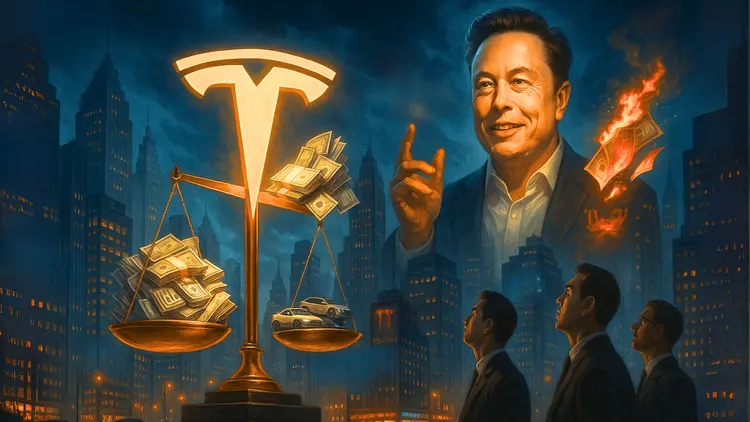
Tesla dazzled investors again this past weekend with the long-anticipated debut of its robotaxi service. The autonomous vehicles, gliding driverless through the streets of Austin, Texas, were supposed to be the latest proof of Elon Musk’s genius. But while the sleek visuals had fans celebrating, seasoned market strategists weren’t clapping. They were calculating—and what they see doesn’t add up.
Chad Morganlander of Washington Crossing Advisors summed it up in one word: insane. Not the tech, but the stock’s valuation. He points out that Tesla trades at ten times revenue and carries a forward price-to-earnings multiple of 178. That’s nearly nine times higher than the average S&P 500 company. “There’s a lot of jazz hands going on here,” Morganlander said on Yahoo Finance’s Opening Bid. “You look at that multiple and it’s hard to imagine them growing into that in any short period of time.”
He’s not alone in that assessment. As Tesla fans cheer the future, the fundamentals are flashing red. Tesla’s earnings per share forecasts for the next three years have collapsed, down by as much as 77 percent since late 2022. Meanwhile, the company’s dependence on government tax credits remains dangerously high. According to JPMorgan analyst Ryan Brinkman, federal subsidies now account for more than half of Tesla’s profit. And if those are eliminated by a Trump-led administration, Tesla could face a swift and painful margin reckoning.
It’s not just a numbers problem. The entire premise of Tesla’s robotaxi rollout is raising eyebrows. The company’s bullish thesis hinges on the idea that thousands of Teslas will cruise city streets in full autonomy, picking up passengers and earning cash. But the math doesn’t work. These vehicles are expected to make less than $10 per ride. That’s not nearly enough to justify the towering valuation investors have placed on the stock.
Compare that to <a class="tvreplink" target="_blank" href="https://www.tradingview.com/chart/?symbol=Nasdaq%3AGOOG">Alphabet’s Waymo. The autonomous taxi division of Google’s parent company has been operational since 2018, first launching in Phoenix and now expanding into more urban markets. Morganlander says he owns shares of Alphabet instead. Why? Because it’s a proven platform, quietly building a real business without the flash. “We believe that this whole robotaxi idea that you’re going to let your car go out in the middle of the night and pick up drunk people just to make money is perhaps a little bit foolhardy,” he added.
Tesla has always thrived on spectacle. Elon Musk’s charisma, vision, and relentless showmanship have driven the stock to astronomical highs. But as investors begin to sober up, the gap between narrative and reality is becoming harder to ignore. Tesla missed expectations on both revenue and profit in the first quarter. That stumble, combined with slowing EV demand and rising political controversy around Musk himself, has sparked new concern that the company is finally hitting a wall.
Tim Urbanowicz, chief investment strategist at Innovator ETFs, echoed that caution. He noted that Tesla projects are often delivered late, over budget, or underwhelming. “As with anything that we've seen from Tesla, it always takes longer than Elon Musk thinks and investors think,” he said. That kind of delay might be tolerable when the valuation is grounded in reality. But at 178 times earnings? Not so much.
It’s easy to get swept up in the Tesla hype machine. For years, the company has redefined what’s possible in transportation, battery storage, and autonomous driving. But the question now is whether the stock price reflects progress—or fantasy. With EPS projections plummeting, tax incentives possibly disappearing, and competitors like Waymo advancing under the radar, the market’s patience may soon wear thin.
Tesla is still a force in the electric vehicle world. It still has unmatched brand recognition, a passionate base, and powerful technology. But those factors alone aren’t enough to support a valuation of this magnitude. Investors should ask themselves a simple question: if Tesla weren’t called Tesla, would this stock trade where it does today? For many strategists, the answer is a firm no.
Conclusion
Tesla's latest leap into robotaxis might look futuristic, but under the surface lies an uncomfortable truth: the numbers don’t support the hype. Wall Street strategists are calling out the valuation for what it is—excessive, inflated, and out of touch with earnings trends. With EPS forecasts falling, tax breaks at risk, and competitors gaining traction, Tesla’s reality check may arrive sooner than investors expect.