
TD’s Oil Picks Are Ready to Flow, If Carney Opens the Valves
TD Securities backs Imperial Oil, Athabasca Oil, and Strathcona Resources as Canada awaits Prime Minister Mark Carney’s new “major projects” announcement that could reshape the country’s energy future.
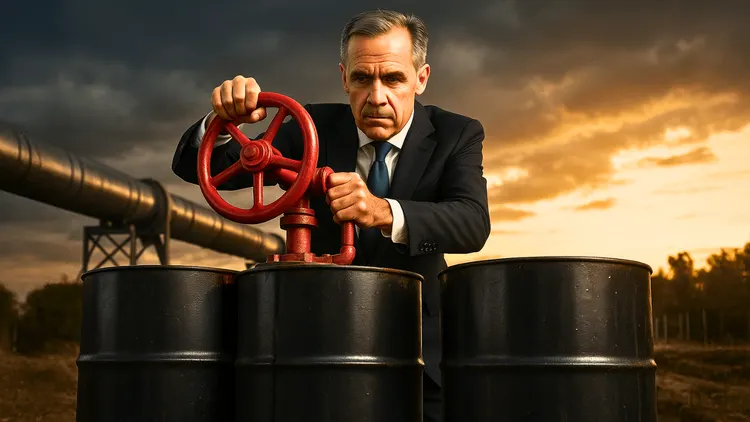
As Canada’s oil sector holds its breath for Prime Minister Mark Carney’s upcoming list of “major projects,” analysts at TD Securities are already placing their bets on which energy players stand to gain. With the announcement set for Thursday in Prince Rupert, B.C., the focus is squarely on one word that has defined Canada’s energy narrative for decades: pipelines.
For a nation rich in oil but constrained by infrastructure, the return of pipeline politics marks both an opportunity and a risk. TD’s latest research report doesn’t mince words—future profits will hinge on “takeaway capacity,” the industry’s ability to move crude efficiently from Alberta’s oil sands to overseas markets.
Pipeline Progress and Political Theater
Carney’s government has teased a “living list” of major infrastructure projects, following September’s first batch of fast-tracked proposals that included LNG Canada’s Phase 2, a small modular nuclear reactor, and several port and mining expansions. But the oil industry’s attention remains fixed on whether pipelines will make the cut.
When pressed about new projects during a recent Canadian Club event, Carney brushed off the question with characteristic wit, saying, “Don’t worry, we’re on the pipeline stuff. Danielle’s on line one,” referring to Alberta Premier Danielle Smith. The remark drew laughs, but behind the levity lies a tension that defines Canada’s energy future: the clash between political caution and industrial urgency.
TD’s Energy Picks: Betting on Capacity and Crude
TD Securities’ Menno Hulshof and his team have identified three top performers in the current environment—Imperial Oil (TSX: IMO), Athabasca Oil (TSX: ATH), and Strathcona Resources (TSX: SCR). These companies, they argue, are best positioned to capitalize on stronger heavy oil prices and potential new export capacity between now and 2028.
In their base-case scenario, TD projects the industry will add roughly 270,000 barrels per day of pipeline capacity by 2030, primarily through optimization rather than entirely new builds. The analysts place a 90 percent probability on this happening, assuming Canada can hold the discount on heavy crude—known as the WCS-WTI differential—at or below US$14 per barrel.
This differential, the gap between Canadian heavy crude and the U.S. benchmark, has long been a barometer of Canada’s export struggles. When infrastructure lags production, the discount widens. In 2018, it ballooned to over US$43, hammering producers’ profits and forcing government interventions. TD’s report warns that without timely new capacity, history could repeat itself by the late 2020s.
The Cost of Delay and the Lessons of TMX
The Trans Mountain Expansion (TMX) was heralded as a triumph when it finally came online in May 2025, but its completion after 12 years of regulatory and political wrangling is a sobering reminder of how long these projects can take. Coastal GasLink, too, took a decade to complete. TD’s Hulshof cautions that “Canada’s recent track record of pipeline construction would suggest we may already be timing out.”
This means even modest new capacity must be planned and executed with urgency if the country wants to prevent future bottlenecks. The analysts note that the visibility on new large-scale pipeline projects remains “low,” with companies like Enbridge (TSX: ENB) and TC Energy (TSX: TRP) prioritizing their U.S. operations instead of domestic expansions.
Winners and Losers in the Infrastructure Game
While producers like Imperial, Athabasca, and Strathcona could gain from higher heavy crude prices, the midstream story is more mixed. TD expects Gibson Energy (TSX: GEI) and South Bow Corporation (TSX: SOBO) to be negatively impacted under their base-case scenario, while Enbridge stands to benefit due to its dominant egress network and ability to expand capacity incrementally.
Meanwhile, Keyera (TSX: KEY) and Pembina Pipeline (TSX: PPL) could see upside if overall crude output climbs, given the associated rise in condensate demand—a vital diluent for transporting heavy oil through pipelines.
Carney’s Balancing Act
For Carney, the challenge is as political as it is logistical. The prime minister’s green agenda, underscored by a push for modular nuclear and renewables, must coexist with the economic realities of Canada’s oil sector. Alberta’s oil sands remain a cornerstone of national revenue, and the sector’s employment base ensures that pipeline development remains a political flashpoint.
Carney’s characterization of the pipeline debate as “boring” may have been an attempt to defuse tensions, but it also signals confidence that his government can strike a balance between environmental priorities and industrial pragmatism. His upcoming announcement from Prince Rupert could reveal whether that balance tilts toward oil, renewables, or both.
A Sector Holding Its Breath
Investors, meanwhile, are parsing every signal. TD’s note to clients makes it clear that the next few years will test the patience of even the most bullish energy investors. The report concludes that “the companies that screen most favorably are those with material leverage to tighter heavy differentials,” but it also warns that without clear federal direction, the industry risks slipping back into old cycles of overproduction and under-capacity.
The bottom line: Canada’s oil industry isn’t waiting for miracles, just momentum. And for now, that momentum lies in Mark Carney’s hands.
Conclusion
As the energy world watches Prince Rupert, the stakes couldn’t be higher for Canada’s oil sector. TD Securities has drawn the roadmap, highlighting the companies most ready to ride the next wave of pipeline optimization. Yet without decisive federal leadership, the promise of new capacity could fade into yet another round of delays and discounts. The message is clear—Canada’s energy future depends not on resources, but on resolve.