
Reef or Riches? Trump Swims Toward Seabed Leases
Trump Greenlights Seabed Lease Talks as Deep-Sea Mining Emerges as America’s Next Strategic Frontier
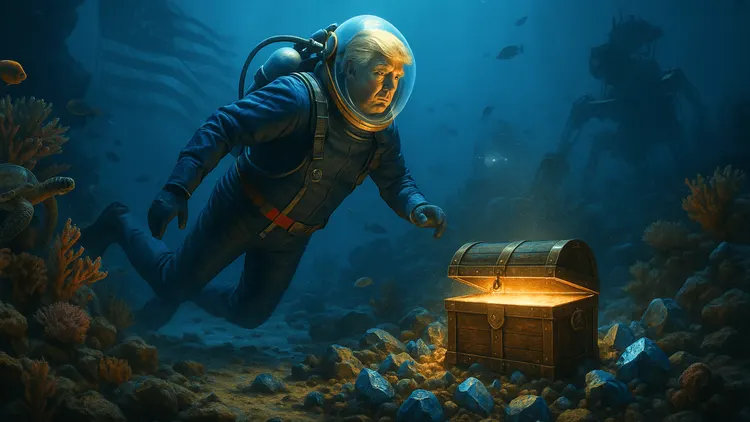
In a move that could ignite both opportunity and outrage, the Trump administration has announced it will evaluate a request to sell leases for deep-sea mining of critical minerals in the waters off American Samoa. The announcement, made on Wednesday by the Department of the Interior, marks the first concrete step in what could become a full-throttle push into seabed mining—an industry as controversial as it is lucrative.
The request came from California-based company Impossible Metals, which seeks to extract cobalt, nickel, and other essential minerals from the ocean floor—resources vital for electric vehicles, advanced weapons systems, and high-tech manufacturing. As tensions with China escalate and the global race for critical minerals intensifies, the Trump administration is wasting no time in putting U.S. seabed resources on the table. Last month, President Trump signed an executive order that directs the National Oceanic and Atmospheric Administration to fast-track permitting for deep-sea mining operations in both U.S. and international waters. The message is clear: America wants to reduce its dependence on Chinese supply chains, and it's willing to go to the depths to do it.
Interior Secretary Doug Burgum emphasized the national security implications, stating that “critical minerals are fundamental to strengthening our nation’s resilience and safeguarding our national interests.” He confirmed the Bureau of Ocean Energy Management (BOEM) will now launch a multistep evaluation, beginning with a request for public input. While the plan remains in its early stages, the tone from Washington is unmistakable—this administration is open for underwater business.
But not everyone is applauding. Environmentalists have come out swinging, warning that mining the seabed could unleash devastating impacts on fragile ecosystems and threaten ocean health globally. “We’re ready for a fight,” declared Miyoko Sakashita, oceans director at the Center for Biological Diversity. “Trump’s dangerous deep-sea mining obsession worsens with every move. Mining the ocean floor will damage fragile habitats and unique critters we haven’t even discovered yet.” Scientists also caution that disturbing the seabed could disrupt the ocean’s ability to sequester carbon dioxide, thereby worsening climate change—a threat already hanging heavy over island communities like American Samoa.
The debate over seabed mining is far from new, but Trump’s aggressive pivot has reignited global concern. More than 30 countries, numerous environmental groups, fisheries coalitions, and even some automakers and tech giants have already called for a moratorium. They argue that no mining should proceed until robust international regulations are established. Ironically, the United States is not a party to the UN-affiliated International Seabed Authority, which has yet to finalize global rules. That loophole could allow U.S.-based firms like Impossible Metals to bypass international scrutiny entirely by focusing on American territorial waters.
Impossible Metals, for its part, claims to have the answer. On its website, the company touts an autonomous underwater robot guided by artificial intelligence—designed to harvest metals while minimizing harm to marine life and habitat. Whether that technology can deliver on its promises remains to be seen, but it hasn’t stopped the criticism. Critics argue that no level of technological polish can eliminate the risks of disturbing complex and little-understood underwater ecosystems.
As the evaluation process moves forward, the BOEM is expected to collect input from industry stakeholders, environmental groups, scientists, and the general public. That feedback could shape the course of what may become one of the most contentious resource extraction efforts of the decade. Still, the administration’s posture suggests it’s ready to press ahead, eyes firmly locked on mineral independence.
The geopolitical backdrop adds fuel to the fire. China currently dominates global processing of critical minerals, including 60% of global cobalt and over 80% of refined nickel supply. With deepening trade tensions and an escalating rivalry in technology and defense sectors, Washington views seabed mining not just as an economic opportunity but a strategic imperative. In this context, the decision to consider leasing mineral rights in American Samoa is more than an isolated move—it’s part of a broader chess game.
Canada-based The Metals Company has already made headlines for its intent to file applications for international seabed mining through a U.S. subsidiary. That would place it on the leading edge of a new frontier, racing against time, technology, and regulation. Impossible Metals may be the first to push for commercial auctions in U.S. territory, but it certainly won’t be the last.
In the end, this story is about more than minerals. It’s about the values we prioritize, the risks we’re willing to take, and the kind of world we want to build—above and below the waves. Will the lure of mineral independence outweigh the costs to biodiversity and climate? Will technology truly mitigate harm, or are we diving into unknown depths with blindfolds on?
The Trump administration is poised to find out. And so are we.
Conclusion
The Trump administration’s willingness to entertain seabed mining leases signals a seismic shift in America’s critical minerals strategy. With Impossible Metals eager to dive in, the stage is set for a high-stakes showdown between economic ambition and environmental caution. As the BOEM launches its multistep evaluation, public input will play a vital role in shaping the future of U.S. seabed mining. Whether this effort leads to a deep-sea gold rush or a legal and ecological quagmire remains to be seen. But one thing is clear—America’s hunger for critical minerals is plunging into uncharted waters.