
High-Grade Assays and US$60M Inbound Offers Push Lithium Africa Toward 2027 Production
A US$60 million Fortune Global 500-backed proposal and a trading house prepayment facility give the junior miner competing fast tracks to 2027 spodumene production.
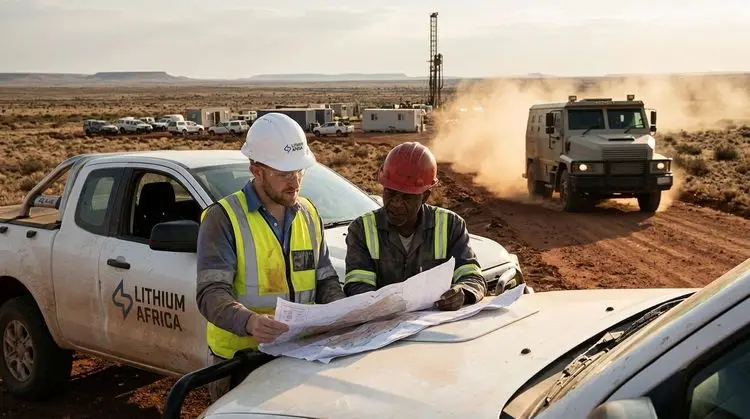
Junior mining usually requires wandering through a funding desert, but Lithium Africa Corp. (TSXV: LAF, OTCQB: LTAFF) suddenly finds itself sorting through an embarrassment of riches in South Africa’s arid Northern Cape Province.
The Vancouver-headquartered developer has fielded two competing, non-binding financing proposals to propel its permitted Springbok Project into production, headlined by a USD 60 million cash infusion proposal from a lithium processing specialist backed by a Fortune Global 500 powerhouse.
The dual bids present management with a classic strategic dilemma, pitting near-term, self-funded agility against deep-pocketed industrial expansion. On one side stands a proposed prepayment facility from an international commodity trading house, paired with a three-year offtake agreement covering 100% of the project’s initial spodumene concentrate. On the other sits the USD 60 million investment proposal, which would see the Fortune Global 500-backed processor acquire a 55% stake in a new holding company that will house the 70% operating interest held in Namli Exploration & Mining (Pty) Ltd.
The sudden rush of institutional suitors is hardly accidental; it arrives directly on the heels of eye-catching shallow drill assays reported just days earlier at Springbok's Norrabees I prospect. There, diamond drilling intersected 8.0 meters grading 1.70% lithium oxide from just 21 meters downhole, headlined by a standout 4.0-meter interval grading 2.59% lithium oxide and individual core intervals peaking at 4.11%. With three rigs actively spinning across 21 identified pegmatite targets, the company demonstrated the kind of high-grade, near-surface strike that critical mineral supply chains are quietly scrambling to lock down.
That geological momentum explains the robust math behind the USD 60 million proposal. The offer places an implied pre-money valuation of roughly USD 70.1 million on 100% of Namli Exploration & Mining (Pty) Ltd. Under the contemplated structure, Lithium Africa Corp. (TSXV: LAF) would retain a 45% stake in the holding company, yielding an indirect 31.5% net interest in the underlying operating vehicle, with that retained position valued at approximately USD 49 million on a post-money basis. Crucially, the junior would not have to write a single check to support the program, which allocates roughly USD 10 million for district-wide exploration drilling and USD 50 million to erect a full-scale processing facility, leaving the remaining 30% project-level interest held by local Broad-Based Black Economic Empowerment partners untouched.
For Chief Executive Officer Thomas Benson, the competing overtures validate a counter-cyclical push to unlock shovel-ready assets. The Springbok asset sits entirely outside the company’s separate 50/50 West and Southern African exploration joint venture with GFL International Co., Ltd., an affiliate of Ganfeng Lithium Group Co., Ltd. (SZSE: 002460, HKEX: 1772), leaving the team with an unencumbered runway to deal make. Benson noted that with more than twenty counterparties currently engaged across offtake, prepayment, equipment vendor financing, and project equity, the board's immediate task is selecting the optimal framework so that small-scale production at Springbok can fund large-scale exploration across the broader district.
Navigating that runway still comes with deliberate risks that will keep conservative mining engineers on their toes. Both proposals remain strictly non-binding, contingent on confirmatory drilling, definitive legal drafting, and regulatory hurdles. More unorthodox is the operational roadmap itself: Lithium Africa Corp. (TSXV: LAF) intends to advance Springbok toward first spodumene concentrate production in the second half of 2027 without first completing a conventional, bankable feasibility study or establishing formal mineral reserves. By leapfrogging the typical multi-year desktop study cycle, the company significantly shortens the path to cash flow, even if doing so invites higher technical and economic uncertainty.
With a definitive project financing verdict targeted for the first half of 2027 and plant commissioning penciled in for the months immediately following, the Karoo is rapidly transitioning from a neglected corner of the critical minerals map into a high-stakes proving ground.
Sources
- Lithium Africa Corp. News Release, "Lithium Africa Receives Two Non-Binding Offers to Fund the Springbok Project, Including a US$60 Million Investment Proposal" (Distributed via Newsfile Corp., October 20, 2026).
- Lithium Africa Corp. News Release, "Lithium Africa Intersects 8.0 m at 1.70% Li2O, including 4.0 m at 2.59% Li2O, Extending High-Grade Mineralization at Norrabees I" (Distributed via Newsfile Corp., October 15, 2026).
Disclaimer
Neither the author of this article nor JuniorStocks holds equity, stock options, or any other financial positions in Lithium Africa Corp. (TSXV: LAF; OTCQB: LTAFF; FSE: 6MQ) or any other companies mentioned in this publication. This content is published by JuniorStocks.com strictly for informational purposes, was prepared independently without company compensation, and utilized AI assistance for text editing, formatting, and generating accompanying media. While hard-rock lithium and South Africa’s Springbok Project represent a compelling development in the critical minerals sector, this article does not constitute investment or financial advice. Investors are strongly advised to conduct their own thorough, independent due diligence and consult with a qualified financial professional before making any investment decisions.