
Critical Minerals, Critical Countdown: 90 Days to Get It Right
A Temporary Tariff Thaw Unlocks Critical Minerals, but Can the U.S. Seize the Moment?
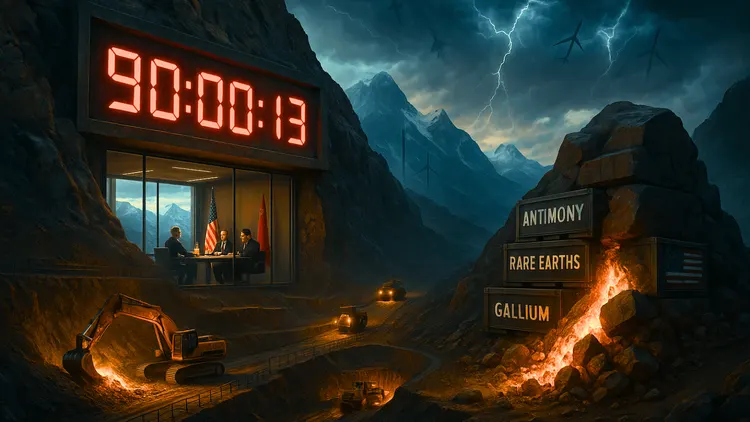
In a world where trade wars flare hotter than a steel furnace, the U.S. and China have decided to play nice—for 90 days, at least. Announced on May 12, 2025, after weekend talks in Geneva, this bilateral deal slashes tariffs and pries open China’s grip on critical minerals like antimony, rare earths, and gallium. It’s a diplomatic detente that’s got markets buzzing and miners dreaming, but don’t pop the champagne yet. This truce is a Band-Aid on a fractured supply chain, and for critical minerals—vital for everything from fighter jets to solar panels—the stakes are sky-high. Let’s unpack the deal, zoom in on the minerals that keep the world spinning, and ask: is this a game-changer or just a geopolitical timeout?
The Deal: Tariffs Down, Minerals Up
Picture this: U.S. Treasury Secretary Scott Bessent and Trade Representative Jamieson Greer squaring off with China’s Vice Premier He Lifeng in a Geneva conference room, hammering out a deal to cool the trade war’s latest inferno. The result? Starting May 14, 2025, tariffs on Chinese goods entering the U.S. drop from a jaw-dropping 145% to a still-hefty 30%, while U.S. goods heading to China see duties fall from 125% to 10% Fast Markets, May 13, 2025. But the real kicker for the mining crowd? China’s agreed to lift its export bans on critical minerals, imposed since April 2, 2025, which had choked off supplies of antimony, rare earths, and other high-tech essentials White House Joint Statement, May 12, 2025.
This isn’t just about numbers—it’s about survival. Critical minerals are the lifeblood of modern tech and defense. Rare earths power magnets in wind turbines and missiles; antimony hardens armor-piercing rounds; gallium keeps semiconductors humming. When China slammed the brakes on these exports in April 2024, prices skyrocketed—antimony alone hit $40,000 per ton, a 250% jump in a year Reuters, April 4, 2025. The U.S., which imports 63% of its antimony and 82% of its rare earths from China, felt the squeeze hard Bloomberg, April 16, 2025. This deal buys breathing room, but it’s a 90-day sprint, not a marathon victory.
Why Critical Minerals Are the Real Story
Let’s cut to the chase: critical minerals aren’t just rocks—they’re geopolitical chess pieces. China produces 48% of the world’s antimony and 90% of its rare earths, giving it a near-stranglehold on global supply TRENDS Research, February 11, 2025. When Beijing flexed its muscle with export bans in August and December 2024, U.S. defense contractors and clean energy firms scrambled. X users like @Artemisfornow were quick to sound the alarm: “China’s got us by the throat with antimony—80% of global supply. Time to mine our own!”
The trade deal’s promise to lift these restrictions is a win, but it’s not a free pass. The White House confirms China will “suspend or remove” its non-tariff barriers, including those pesky mineral bans Fast Markets, May 13, 2025. Yet, sectoral tariffs on autos, steel, and aluminum remain, and investigations into critical minerals tariffs are still simmering. Translation? The mineral market’s relief might be “muted,” as Fast Markets puts it, and the U.S. isn’t out of the woods.
The U.S. Response: Digging for Independence
The U.S. isn’t sitting on its hands. President Trump’s April 15, 2025, Executive Order launched a probe into the national security risks of imported critical minerals, signaling a push for self-reliance White House Fact Sheet, April 2025. On the ground, Perpetua Resources’ Stibnite Gold-Antimony Project in Idaho is a beacon of hope, with 148 million pounds of antimony reserves and $59.2 million in Defense Production Act funding. It could cover 35% of U.S. demand, but it’s years from full production. Meanwhile, the DOE’s $45 million investment in critical minerals consortia and U.S. Antimony Corporation’s Montana smelter expansion show the private sector’s waking up Mining Technology, January 14, 2025.
Allies are stepping up, too. Tajikistan, the world’s second-largest antimony producer, is cozying up via the C5+1 Critical Minerals Dialogue, while Australia’s nascent projects offer promise. But let’s be real: building mines and refineries takes time, and China’s Belt and Road Initiative is snapping up mineral assets from Indonesia to Africa AISI Statement, May 12, 2025. The U.S. needs to move faster than a startup chasing venture capital.
Market Buzz and Economic Jolt
Markets love a good truce. Share prices for auto and steel companies spiked, with the U.S. dollar and oil climbing while gold took a breather Reuters, May 12, 2025. Economists are downright giddy: UBS’s Jonathan Pingle predicts a 0.4% GDP boost for the U.S. this year, while J.P. Morgan upped China’s 2025 growth forecast to 4.8% Fast Markets, May 13, 2025. Businesses are exhaling, planning back-to-school imports with a bit more swagger, though 30% tariffs on Chinese goods still sting, as Oklahoma State’s Sunderesh Heragu notes.
For critical minerals, the deal’s a lifeline. Antimony miners, for instance, can breathe easier knowing China’s export ban is off the table—for now. But steel industry voices, like a distributor quoted by Fast Markets, warn that transshipping through Southeast Asia and Canada keeps Chinese influence alive. “A half-trillion trade deficit is too high,” they grumble, and they’re not wrong.
What’s Next? A 90-Day Countdown
This deal’s no fairy-tale ending. It’s a 90-day ceasefire, with high-level talks slated to continue between Bessent, Greer, and He Lifeng in the U.S., China, or a neutral third country Washington Post, May 12, 2025. The White House promises a “mechanism” for ongoing trade discussions, but details are scarcer than a domestic antimony mine. David Zervos of Jefferies sums up Trump’s style: “Big, destabilizing moves, then pull everyone back.” It’s classic brinkmanship, and it’s working—for now CNBC, May 12, 2025.
The risk? China’s got a playbook for weaponizing minerals, as seen in 2024’s bans. X user @TorstenProchnow put it bluntly: “China’s not playing nice forever. We need mines, not promises.” The U.S. must use this window to fast-track projects like Stibnite, streamline permitting, and lock in allied supplies. The Atlantic Council argues tariffs could secure mineral supply chains if targeted smartly Atlantic Council, April 18, 2025. Otherwise, when the 90 days are up, we’re back to square one.
The Bottom Line
The U.S.-China trade deal is a rare win in a world of tit-for-tat tariffs, putting critical minerals back on the table and giving industries a much-needed breather. But let’s not kid ourselves: 90 days is a blip, and China’s mineral muscle isn’t flexing any less. For antimony, rare earths, and gallium, the U.S. needs to dig deep—literally. From Idaho’s mountains to Tajikistan’s mines, the race is on to build a supply chain that doesn’t bow to Beijing. As Ahmad Assiri of Pepperstone quips, this is “a reverse Liberation Day”—not a fix, but a chance to pivot Fast Markets, May 13, 2025. So, miners, investors, and policymakers, grab your shovels. The clock’s ticking, and the stakes are critical.