
Chris Wright Confirms U.S. Nuclear Promises Are Turning Into Projects
America’s nuclear revival accelerates as the Energy Department channels billions into new reactors and AI-driven power demand reshapes the grid.
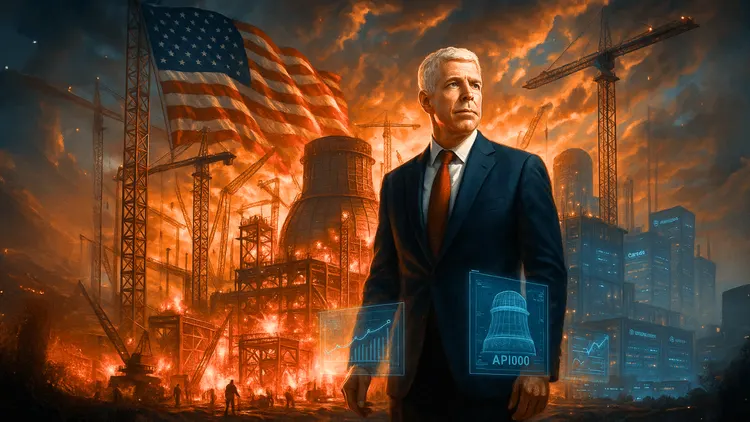
The United States is preparing for one of the most aggressive nuclear buildouts in its modern energy history as Energy Secretary Chris Wright confirmed that nuclear power will receive the majority of financing from the Energy Department’s loan office. His message delivered at the American Nuclear Society’s gathering in Washington was unmistakably clear. Nuclear is no longer a peripheral component of America’s energy mix. It is about to become its backbone.
Wright emphasized that the department’s lending firepower is poised to reshape the nation’s energy infrastructure. He expects the loan program office to deploy its capital primarily toward nuclear plants in an effort to meet soaring electricity demands and national security goals. This move aligns directly with President Trump’s executive order calling for the United States to break ground on ten large-scale nuclear reactors before 2030.
The administration’s nuclear push is unfolding against a backdrop of exploding demand from artificial intelligence data centers. Tech giants including <a class="tvreplink" target="_blank" href="https://www.tradingview.com/chart/?symbol=Nasdaq%3AGOOG">Alphabet, Amazon, Meta Platforms and Microsoft are already investing billions into reviving old reactors, upgrading existing ones and fast-tracking next-generation technologies to guarantee the vast energy supply required to power their AI expansions.
The AI Power Surge Driving Private Capital Toward Nuclear
Wright pointed to one of the most remarkable developments in the energy sector today. The rapid ascent of AI has fundamentally shifted the investment landscape. Electricity demand is rising at levels not seen in decades and nuclear energy is emerging as the only scalable, reliable and carbon-free solution capable of meeting this moment.
Major corporations with some of the strongest balance sheets in the world are now pouring equity into nuclear builds. Wright expects this trend to accelerate with billions more in private capital flowing into new reactors over the next few years. The Energy Department plans to match these investments with low-cost federal financing at ratios as high as four to one which could produce a modern nuclear renaissance unlike anything in U.S. history.
The Secretary’s vision is ambitious. He wants dozens of nuclear plants under construction by the time the administration completes its term. This is not aspirational rhetoric he insisted. It is the direction of U.S. energy policy and government-backed financing.
The Westinghouse Deal That Could Reshape the Grid
A crucial pillar of this nuclear expansion is the Trump administration’s monumental agreement with Westinghouse. Last month the White House entered a deal with the owners of Westinghouse to commit eighty billion dollars toward building new reactors across the country. Westinghouse which is jointly owned by Cameco and Brookfield Asset Management has positioned its AP1000 reactor as its flagship design.
Capable of powering more than seven hundred fifty thousand homes the AP1000 is considered one of the most advanced and efficient large reactors on the market. CEO Dan Sumner reiterated earlier this year that Westinghouse is prepared to meet the President’s call for new large-scale builds using this design.
Cameco’s COO Grant Isaac recently stated that the U.S. government has multiple tools available to help finance these reactors including the pivotal loan office. He also confirmed that investor interest in the eighty billion dollar commitment is strong and growing.
The October deal also opens the door for a dramatic corporate shift. Westinghouse could potentially spin out as its own publicly traded company with the U.S. government securing a shareholder position. Such a move would cement America’s strategic influence over the future of nuclear technology.
A Complicated History That Still Haunts the Industry
Nuclear optimism is running high, but the industry’s past failures still cast a long shadow. Westinghouse itself collapsed into bankruptcy in 2017 after crippling cost overruns from major AP1000 projects in Georgia and South Carolina. The South Carolina project was abandoned and the Georgia reactors at Plant Vogtle were delivered years late and billions over budget.
Two AP1000 units at Vogtle finally entered service in 2023 and 2024 but the delays remain a cautionary tale. As the new federal push intensifies questions persist about whether the United States can build nuclear reactors efficiently and profitably at scale.
The administration insists this time is different. With streamlined approvals increased federal support and unprecedented private-sector participation Washington believes the U.S. can overcome its old stumbling blocks.
A Moment of Political and Strategic Momentum
Wright reinforced the administration’s message with a bold statement posted on his official Twitter account. Promises made. Promises kept. The promise of American nuclear power is rapidly becoming a reality thanks to President Trump’s commitment to unleash affordable reliable and secure nuclear energy.
His comments reflect the fusion of energy security politics and the technological revolution now underway. Nuclear is no longer merely an environmental or economic debate. It is a national priority backed by a White House eager to reestablish the United States as a global nuclear leader.
The significance of this new direction is difficult to overstate. If the administration’s plans move ahead as outlined the United States could see more nuclear reactors break ground in the next five years than in the previous three decades combined.
Conclusion
The surge of federal financing, corporate investment and political willpower is bringing nuclear power back to the center of America’s energy future. With AI driving unprecedented electricity demand and Washington committing billions to modern reactors the nation is on the cusp of a nuclear transformation that could define its economic and technological strength for decades. Whether the industry can avoid past pitfalls remains uncertain but the momentum behind nuclear energy has never been stronger.