
Beijing's Grip Tightens: How China Is Strangling Western Military Supply Chains
Beijing’s export crackdown on critical minerals exposes the West’s military vulnerabilities and puts defense contractors on high alert.
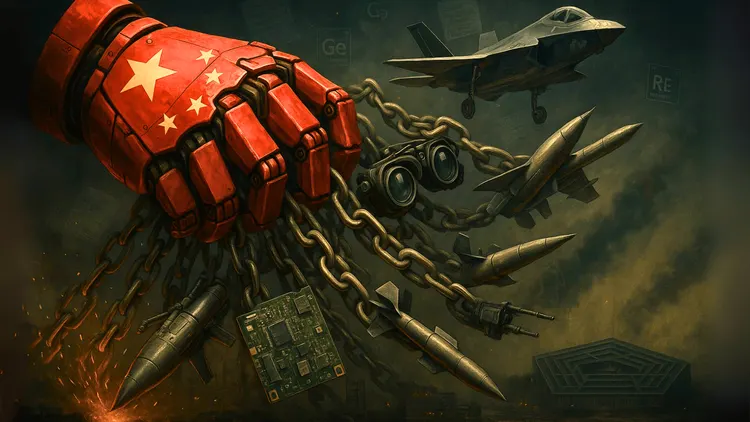
China has drawn a sharp line in the sand. In a strategic move that’s reverberating across the global defense sector, Beijing has tightened its grip on critical mineral exports, applying pressure right where it hurts the West the most—its military supply chain. Rare earths, gallium, germanium, antimony—the lifeblood of modern defense technology—are now caught in a geopolitical tug-of-war, with China in the driver’s seat and the United States scrambling to catch up.
In a world increasingly defined by who controls the supply chains, Beijing’s stranglehold on rare earths has become a powerful geopolitical weapon. The stakes couldn’t be higher. From advanced drone motors to night-vision goggles, missile guidance systems, and the F-35 jet’s engine magnets, the U.S. defense industrial base is woven together with minerals that overwhelmingly originate in Chinese soil. It’s a reality that’s been ignored for too long, and now it’s threatening to unwind America’s technological edge.
Earlier this year, as trade tensions between Washington and Beijing boiled over, China escalated the conflict by slapping new restrictions on rare earth exports. Although a temporary thaw came after the Trump administration granted concessions in June, China didn’t budge on materials destined for defense purposes. The message was crystal clear: the minerals may flow, but not for your missiles.
And now the consequences are biting. One U.S. drone parts manufacturer, dependent on rare earth magnets sourced from China, has had to delay orders by up to two months. Costs have surged. Samarium, an essential ingredient for magnets that survive the fiery heat of jet engines, is now going for up to 60 times its normal price. Germanium, critical for infrared sensors used in missiles and satellites, is in such short supply that defense contractors like Leonardo DRS are down to their “safety stock.” Some companies are just weeks away from production paralysis.
The impact isn’t just financial. It’s strategic. Beijing’s ability to constrict access to minerals has become a form of soft power, a silent but potent tool that doesn’t require firing a shot to weaken adversaries. In fact, more than 80,000 parts in U.S. weapons systems are now tied to minerals under Chinese export control. These are not luxuries. They are the building blocks of warfighters’ gear and battlefield supremacy.
Western defense companies are being forced to rethink their supply chains at a pace they’re clearly not ready for. Startups like Vulcan Elements in North Carolina and USA Rare Earth in Oklahoma are trying to scale up domestic production, but they won’t be delivering usable materials until at least the end of the year. Meanwhile, traders report that China is blocking stockpiling by requiring detailed declarations about end-users, including product photos and production line images—something no Western defense firm is willing to provide. The Chinese want transparency, but only for control.
This isn’t the first time Beijing has used its mineral dominance as leverage. In 2010, after a maritime dispute with Japan, China cut off rare earth exports to Tokyo, sending shockwaves through the electronics industry. Fast forward to today, and it’s clear the same playbook is back in action, only this time the target is the U.S. military.
And it’s not just rare earths. China has also banned exports of germanium and gallium since December, both essential in night vision and high-performance electronics. The implications ripple far beyond the Pentagon. Smaller defense startups, many of them struggling with thin margins and limited stockpiles, are especially vulnerable. Without access to these inputs, they face not only production delays but existential threats.
Take the case of ePropelled, a New Hampshire-based company making propulsion motors for drones. Its Chinese supplier demanded drawings, photos, and lists of clients to ensure that rare-earth magnets weren’t headed for defense use. ePropelled refused—and shipments halted. Orders to customers were delayed by up to two months, and even when the company tried to source materials from Japan and Taiwan, they still found that those magnets relied on Chinese-origin rare earths. There’s no easy way out.
The Department of Defense is finally waking up. It’s now offering grants to expand domestic and allied production. A Canadian firm received $14 million to manufacture germanium substrates for defense satellites. In July, the Pentagon went further, agreeing to spend $400 million for a 15 percent stake in MP Materials, the largest rare earths producer in the Western Hemisphere. The move, hailed by Lockheed Martin as groundbreaking, is designed to shore up magnet supplies for F-35 fighters and cruise missiles. But even with this boost, ramping up production takes time.
The clock is ticking, and China knows it. The export restrictions are forcing defense giants like Lockheed Martin and Raytheon to take matters into their own hands. Some are even trying to vertically integrate, securing raw materials themselves rather than relying on sub-suppliers. It’s a sea change in how military contractors view supply chain security—no longer an afterthought but a strategic imperative.
Still, no level of investment or diversification can undo decades of dependency overnight. The infrastructure isn’t there. The processing capabilities are lacking. And in many cases, the West doesn’t even have access to the necessary ore bodies. Some critical minerals simply aren’t economically viable to mine outside of China. Others, like antimony—which is used to harden bullets and projectiles—are mined in Australia, but the refining and processing often still runs through Chinese ports.
Which brings us to one of the most chilling examples of China’s mineral clampdown: a shipment of antimony from Australia bound for the United States Antimony Corporation in Mexico was detained for three months at the Chinese port of Ningbo. This was once a routine route. Not anymore. Chinese customs seized the load in April, ultimately releasing it in July—but only on the condition that it be returned to Australia and not sent to North America. By the time it got back, seals were broken, and the company had to determine whether the cargo had been tampered with or contaminated. The message? China’s control isn’t just policy—it’s enforcement.
All of this underscores one hard truth. The West is no longer just in a race to innovate. It’s in a race to secure the ingredients that make innovation possible. Semiconductors, defense electronics, advanced batteries—none of these are possible without critical minerals. And right now, China’s grip on those minerals is tighter than ever.
The U.S. has responded by establishing the Critical Minerals Forum, aiming to boost production and investment in friendly jurisdictions. But even here, there are hurdles. Permitting timelines are long. Environmental opposition is fierce. And funding, until recently, has been scarce. While the Defense Department is finally loosening the purse strings, it’s clear that without urgent and coordinated action, the U.S. and its allies could find themselves outmaneuvered—not on the battlefield, but in the boardroom.
This is no longer just an economic story. It’s a national security one. Minerals are now weapons. And China’s made the first move.
Conclusion
The minerals war is heating up. China’s stranglehold on the world’s critical mineral supply is more than a geopolitical inconvenience—it’s a full-blown challenge to Western security. The U.S. defense sector has been caught flat-footed, and unless it rapidly builds alternative supply chains and secures reliable sources of these vital elements, its military edge will continue to dull. The age of resource leverage is here, and Beijing is playing the game with ruthless efficiency. The question now is whether Washington and its allies are ready to fight back with equal resolve.