
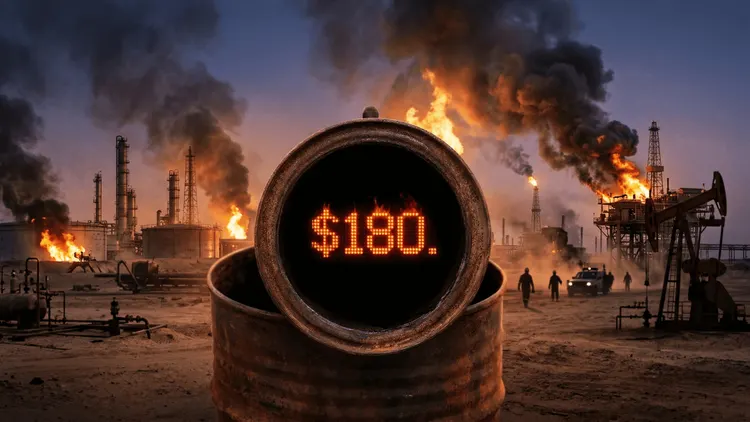
Are We Staring Down the Barrel of $180 Oil as the Middle East Burns?
As the Strait of Hormuz remains paralyzed by regional conflict, Brent crude surges toward $110, forcing global leaders to scramble for solutions before a historic energy crisis suffocates the economy.
The global energy market is currently experiencing the financial equivalent of whiplash. As the conflict in the Middle East nears the end of its third week, Brent crude is aggressively flirting with the $108 per barrel mark. This 5% weekly surge has pushed prices to their highest echelons since mid-2022, fueled by a near-complete closure of the Strait of Hormuz. With the International Energy Agency calculating a staggering 10 million barrels of daily output currently offline, we are witnessing the largest supply disruption in the history of the oil market.
Volatility is the new normal, with daily price swings exceeding $10 as drone and missile strikes target critical energy infrastructure. The recent attack on Iran’s South Pars gas field triggered widespread retaliation against regional facilities, sending not just oil, but European natural gas futures skyrocketing to nearly double their pre-war levels. Kuwait has already shuttered units at its Al Ahmadi refinery following drone strikes, while Saudi Arabia has been busy intercepting incoming missiles.
Despite the chaos, US President Donald Trump is attempting a high-stakes balancing act. During a recent appearance with Japan's prime minister, Trump downplayed the market panic, assuring the public that the situation will be resolved "pretty soon." However, the diplomatic tone shifted on Friday when he labeled NATO allies as "cowards" for their reluctance to help reopen the vital Strait of Hormuz. Meanwhile, Treasury Secretary Scott Bessent is actively exploring aggressive countermeasures. These include a unilateral release of strategic reserves and the potential lifting of sanctions on Iranian oil to artificially deflate surging energy costs, alongside predictions from Bessent that the Iranian regime may internally collapse.
Domestic energy policy is also under the microscope. Following a strategic sit-down between Vice President JD Vance and industry executives, the White House confirmed it has zero intentions of banning US oil and gas exports. The domestic industry successfully argued that an export ban would only hamstring American producers. Consequently, US crude (WTI) is trading at a hefty $13 discount to Brent, bogged down by the highest domestic storage inventories since mid-2024 and the anticipation of emergency reserve releases. Yet, this discount has not saved American drivers, who are currently facing multi-year highs at the pump—a glaring economic and political vulnerability ahead of the upcoming midterm elections.
Financial analysts are understandably sounding the alarm over the duration of this geopolitical standoff. Bjarne Schieldrop, chief commodities analyst at SEB AB (STO: SEB-A), noted that while Iran might choke the Strait of Hormuz until April 20, a full reopening could follow via a US or Israeli initiative, though the exact mechanics remain a mystery. However, analysts at RBC Capital Markets LLC, a division of Royal Bank of Canada (NYSE: RY), paint a far more cautious picture. Helima Croft and her team emphasized that Tehran remains firmly in control of the Strait, noting that even the US strike on Kharg Island, Iran’s primary export hub, failed to alter their strategic calculus.
If this disruption drags into late April, Saudi Arabia’s internal base case projects oil prices soaring past an agonizing $180 a barrel, as originally reported by The Wall Street Journal. With central bankers already sweating over the inflationary risks of a protracted war, the global economy is buckling up for a severely bumpy ride.