
America Dives Deep for Battery Metals in Trump’s New Resource Strategy
Trump greenlights a controversial push to mine EV battery metals from the ocean floor, igniting geopolitical tensions, legal backlash, and a race against China’s dominance.
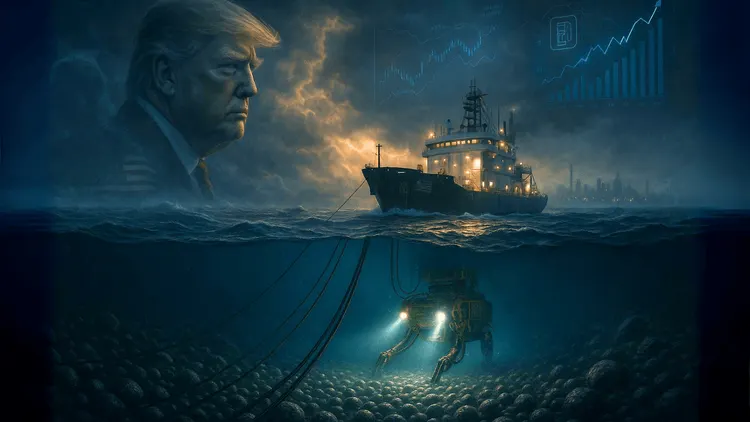
The abyssal plains of the Pacific Ocean are no longer a scientific curiosity. They're now a geopolitical battleground, and at the center of it all is President Donald Trump, who’s fast-tracking deep-sea mining as a counterstrike in America’s growing tech war with China. The focus isn’t climate change anymore, it's critical minerals. The kind that powers electric vehicles, sustains the defense sector, and secures economic dominance. It’s a shift in tone, and ambition, that could change the balance of global resource control.
Gerard Barron, the outspoken CEO of The Metals Company, once framed his pitch in climate terms. Back in 2019, at the United Nations-affiliated International Seabed Authority, he spoke of environmental transition and reducing fossil fuel dependency. Fast forward to 2025, and his language has turned hawkish. Now it’s all about American industrial competitiveness and beating China at the supply chain game. It’s no longer about saving the planet, it’s about securing it.
In April, Trump signed an executive order that essentially declared an undersea gold rush. The White House not only departed from the international consensus on seabed mining regulation but issued a challenge to the world: America will mine the ocean floor to secure its future, with or without your approval. That order opened the floodgates. TMC immediately filed the first-ever application to mine the seabed in international waters. Within days, they secured an $85 million investment from a Korean metals company. The stock surged. Wall Street noticed.
But enthusiasm doesn’t equal readiness. Seabed mining at a depth of four kilometers isn’t something you figure out on the fly. The machines aren’t scalable yet, the economics remain uncertain, and processing infrastructure in the United States is nonexistent. Worse, the international community is watching with clenched teeth. The ISA hasn’t even finalized the rules for mining in global waters, and America’s unilateral approach risks undermining decades of negotiations.
Impossible Metals, a California startup, wants to do things differently. It’s applying for a license to mine within US waters, hoping to raise a billion dollars to make it happen. Its mining system, dubbed “Eureka,” uses robotic arms and artificial intelligence to avoid harming marine life. But even its executives admit commercial operations are likely a decade away. Technological barriers and environmental caution are forcing everyone to slow down, even in the face of political urgency.
Meanwhile, Lockheed Martin quietly signaled interest. A top executive mentioned ongoing discussions about granting access to mining zones in the Pacific. The defense industry, it seems, is positioning itself for a long game, one where control of battery metals could be as vital as hypersonic missiles. Yet, even Lockheed has its limits. The company wouldn’t confirm its plans, but it applauded Trump’s focus on mineral security. That’s telling.
TMC isn’t waiting for approval to celebrate. In 2022, it ran a test off the coast of Mexico using a prototype built by Allseas, a Dutch-Swiss offshore engineering company and TMC’s second-largest shareholder. The machine scraped 3,000 metric tons of polymetallic nodules from the seabed and sent them to a surface vessel. It worked, technically. But scaling that prototype into a full-time mining operation will take years and billions in investment. Allseas is hesitant to proceed without full regulatory clarity. They’re also facing political backlash in the Netherlands for supporting unilateral US action.
And that’s just the hardware problem. The software issue is even trickier. US law mandates that minerals mined under its license must be processed within the country. That’s a problem because America doesn’t have a single facility capable of refining these nodules at scale. Viridian Biometals, a spinoff of Impossible Metals, is trying to change that. In a lab in Pasadena, scientists are experimenting with microbes to extract nickel, cobalt, and copper at room temperature, without toxic waste. The process is promising, but years away from commercialization.
Even if the technology succeeds, scale is a nightmare. According to metallurgical experts, building a full-scale processing facility would cost billions and take a decade. America’s metallurgical know-how has atrophied since the 1980s, and universities have largely abandoned the field. Immigration restrictions only compound the problem by limiting access to global engineering talent. Meanwhile, China continues to dominate. It processes 74 percent of the world’s cobalt ore and controls over 80 percent of the capacity to refine EV battery metals. The US is not just playing catch-up, it’s starting from behind.
TMC has found a temporary workaround. In Japan, Pacific Metals Company agreed to process some of the nodules collected in 2022. They produced a nickel-cobalt-copper alloy in a test run. Encouraged, Pacific Metals announced plans to transition from processing nickel ore to smelting nodules full-time. But the switch won’t be complete until at least 2029. The clock is ticking, and the pipeline is thin.
At the International Seabed Authority’s annual meeting in Kingston, Jamaica, delegates are grappling with Trump’s defiant strategy. The US never ratified the UN Convention on the Law of the Sea but had until recently followed its rules. Now, Washington is essentially ignoring the ISA, moving ahead with mining while the rest of the world is still writing the rulebook. This has become the “blue whale in the room,” a massive, unavoidable presence at the negotiation table.
Legal experts warn of serious consequences. Samantha Robb, an ocean litigation specialist based in Amsterdam, argues that the ISA has jurisdiction, and any mining outside its framework could be considered illegitimate. The risks are not just environmental or political, they’re economic. ISA Secretary-General Leticia Carvalho cautioned that metals produced in violation of international law may face reputational damage, making them less attractive to buyers and investors.
Pacific Metals seems to understand the danger. In a recent briefing, it emphasized the importance of maintaining “international credibility” in nodule processing. That’s code for “we don’t want to get caught in a geopolitical mess.” Whether other processors will follow that logic is unclear. For now, the industry is holding its breath.
As the ISA meeting draws to a close, observers expect a formal response to the Trump administration’s bold move. There’s tension, uncertainty, and a growing divide between countries pushing for a moratorium on seabed mining and those, like the US, ready to roll the dice. The future of critical minerals may lie miles beneath the ocean’s surface, but the battle to control them is happening right here, above the waves, in boardrooms, courtrooms, and diplomatic backchannels.
What began as an environmental initiative has now become a test of international resolve, industrial capability, and political will. Trump’s critical minerals crusade has reignited the race to the bottom of the ocean, but the journey is filled with engineering challenges, legal minefields, and global scrutiny. Whether this gamble secures America’s dominance or isolates it from the world remains an open question.