Agreement to avert the climate catastrophe
UN talks in Scotland end with global agreement
 Gabriel ThomasOctober 5, 2026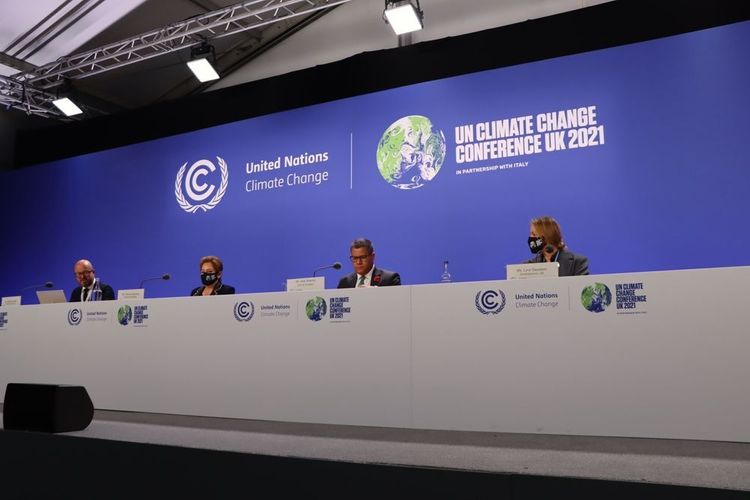
The UN climate talks in Scotland ended with a global agreement that should uphold the hope of limiting global warming to 1.5 degrees Celsius and thus preserving a realistic chance of saving the world from catastrophic climate change.
Alok Sharma, the chairman of the conference, was visibly touched before waving the hammer in relief to signal that the nearly 200 national delegations present in Glasgow - from the coal and gas powered superpowers to the oil producers to those of the surge Pacific Islands threatened by sea levels - had not vetoed.
The two-week conference in Glasgow, spanning an extra day of agonizing negotiation, was the 26th of its kind, but the first to call for a reduction in fossil fuels, which not only power much of the world economy, but also the main culprit are man-made global warming.
Drama erupted at the last minute when India, with the support of China and other coal-dependent developing countries, objected to this part of the deal and asked for the wording to be reformulated. The clause was hastily amended to encourage countries to accelerate their efforts to "phase out" coal-fired power rather than "phase out".
India's Environment and Climate Minister Bhupender Yadav said the revision was necessary to take into account the "national realities of emerging economies".
"We are about to become the voice of the developing world," he told Reuters, adding that coal was "singled out" in the COP26 talks while there was no similar call for phasing out oil or gas.
"We have tried to find a consensus that is reasonable for developing countries and for climate justice," he said, referring to the fact that rich countries have emitted most of the greenhouse gases in the past.
The one-word change in the agreement was received with dismay by the rich economies of the European Union and Switzerland, as well as by a large group of small island states whose existence is threatened by rising sea levels.
However, everyone said they would accept this in the interests of an overall agreement.
"The adopted texts are a compromise. They reflect the interests, the conditions, the contradictions and the state of political will in the world today," said UN Secretary General Antonio Guterres.
"You are taking important steps, but unfortunately the collective political will has not been sufficient to overcome some deep contradictions."
'DEEP DISAPPOINTMENT'
Sharma had the difficult task of balancing the demands of the climate-endangered countries, the major industrial powers and countries like India and China, whose consumption or export of fossil fuels is vital to their economic development.
His voice cracked with emotion as he heard weak nations express their anger at the last minute changes.
"I would like to apologize to all delegates for the way this process has developed and I am very sorry," he said before the meeting.
"I understand the deep disappointment, but I think, as you have noticed, it is also important that we protect this package.
The overarching goal he formulated before the conference was one that climate activists and endangered countries had found far too modest - namely the goal of the 2015 Paris Agreement to limit global warming to 1.5 degrees Celsius above pre-industrial levels to "keep alive".
The agreement acknowledges that commitments made so far to cut emissions of greenhouse gases that warm the planet are nowhere near enough and calls on countries to make stricter climate commitments next year, rather than every five years as is currently the case by they are required.
Scientists say that a rise of more than 1.5 ° C would trigger extreme sea level rise and catastrophes like crippling droughts, massive storms and forest fires far worse than those the world is already suffering from.
The national commitments made so far to reduce greenhouse gas emissions - mainly carbon dioxide from burning coal, oil and gas - would limit the average global temperature increase to only 2.4 ° C.
THE ERA OF COAL IS ENDING
Jennifer Morgan, executive director of the Greenpeace campaign group, saw the glass as half full.
"You changed a word, but you cannot change the signal that this COP sends out that the coal era is coming to an end," she said. "If you are an executive in a coal accelerator, this COP has produced a bad result."
Developing countries argue that the rich nations, whose emissions have historically been largely responsible for warming the planet, will have to pay more to help them adapt and reduce their carbon footprint.
The deal gave the poorest countries more promises, but no guarantees that they would finally get more of the financial aid they had long been promised.
The rich countries were asked to double the funding for climate adaptation by 2025 compared to 2019, which was one of the main demands of the small island states at the conference.
The adaptation funds go primarily to the poorest countries and currently only make up a small part of climate finance.
A UN committee will also report next year on progress in providing the $ 100 billion a year climate finance that rich countries had promised but failed to deliver by 2020. And governments will hold meetings in 2022, 2024 and 2026 to discuss climate finance.
But even $ 100 billion a year is nowhere near enough to meet the real needs of poorer countries, which, according to the United Nations, could amount to $ 300 billion by 2030 just for adjustment costs, in addition to the economic losses caused by crop failures or climate-related disasters.