
$5 Billion US Minerals Fund Could Reshape Global Supply Chains
Washington eyes $5 billion minerals fund to counter China’s dominance and secure America’s industrial future.
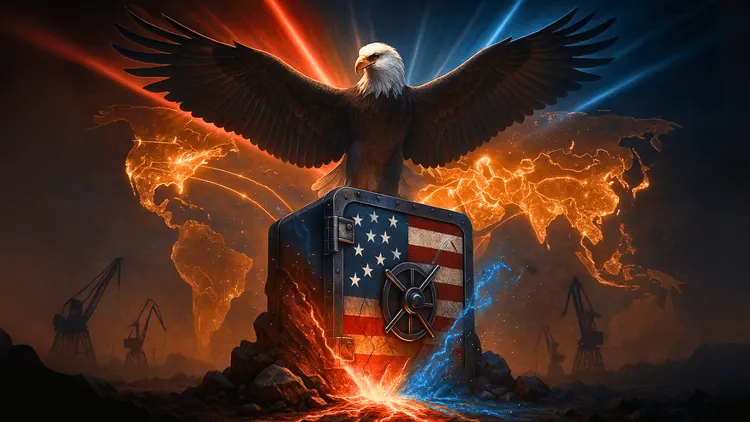
The United States is quietly preparing one of its most significant interventions in global commodity markets in decades. Washington is in talks with Orion Resource Partners, a New York–based private equity firm, to establish a $5 billion fund for critical mineral projects. If the deal comes together, it will mark the clearest signal yet that the U.S. government is no longer content to leave the world’s mining sector to foreign rivals, particularly China.
The proposed fund would be run as a joint venture between the U.S. International Development Finance Corp. (DFC) and Orion, each providing $2.5 billion. The scale would be unprecedented for the DFC, whose mandate has grown rapidly since its creation under Donald Trump’s first term. For the White House, the aim is simple: to secure access to essential metals such as copper, cobalt, and rare earths, which power everything from electric vehicles and clean energy to advanced defense systems.
At the heart of this effort lies growing anxiety about China’s dominance. Beijing controls much of the world’s refining capacity and has aggressively acquired mining assets across Africa, Latin America, and beyond. The U.S., by contrast, has been slower to mobilize its financial firepower. The fund with Orion would be an attempt to catch up, matching Chinese state-backed investment with American capital and know-how. It reflects a wider recognition that access to minerals is no longer just a commercial question, but a matter of national security.
The Congo sits at the center of this battle. Rich in copper and cobalt, it has become a contested arena where Chinese companies hold vast influence. Orion has already teamed with Virtus Minerals, a firm run by former U.S. military and intelligence officials, to bid for Chemaf Resources, a miner previously targeted by Chinese state-owned Norinco. American officials quietly pressed Congo’s government to block that Chinese deal, signaling Washington’s new willingness to intervene directly in mineral politics. If Orion’s bid succeeds, it would be a symbolic victory in the race to control the supply chains of the future.
This push builds on a string of moves by the Pentagon and the DFC. Earlier this year, the Department of Defense invested $400 million in MP Materials, a Nevada rare-earths producer, and guaranteed floor prices to protect it from market downturns. The Pentagon has also relaunched stockpiling programs for cobalt, echoing Cold War–era strategies. Meanwhile, the DFC financed projects like Mozambique’s Syrah Resources graphite mine, which supplies Tesla, and $550 million to modernize Angola’s Lobito Corridor railway, a key route for African mineral exports. The proposed $5 billion venture with Orion would dwarf those commitments, reshaping the agency’s role in U.S. foreign and economic policy.
Politics plays its part too. Trump has put critical minerals at the top of his second-term agenda, touting deals in Ukraine, Greenland, and Africa. He appointed Ben Black, son of Apollo Global Management’s Leon Black, to lead the DFC, though his confirmation remains pending. Black has pledged that the agency will complement, not replace, private capital, while forging closer ties with Wall Street. His selection underlines Trump’s strategy: blending federal leverage with the financial firepower of New York’s elite investment firms.
Oskar Lewnowski, Orion’s founder, has long argued that governments must step into mineral markets the way China has, building stockpiles and securing assets against shocks. His partnership with Washington could prove to be a defining test of that theory. Together, Orion and the DFC would have the capital and credibility to pursue high-risk projects in unstable regions, from Africa to Eastern Europe, where private firms alone might hesitate. Success would give the U.S. a stronger foothold in the most strategic sector of the twenty-first century.
The talks are not guaranteed to succeed, but the direction of U.S. policy is clear. The age of leaving global mining to private investors and foreign governments is over. Washington is preparing to act directly, mobilizing billions in pursuit of mineral security. The stakes are high: without these resources, America’s ambitions for clean energy, advanced defense, and industrial renewal could falter. With them, it gains a fighting chance to compete in a world where raw materials are the new weapons of power.
Conclusion
The negotiations over the $5 billion Orion–DFC fund reveal a shift in how the U.S. views minerals—not as commodities, but as strategic assets. If the deal is finalized, it will be the boldest step yet in America’s attempt to counter China’s grip on global supply chains. The race for copper, cobalt, and rare earths is not just about mining, it is about who controls the future. For Washington, the message is unmistakable: the United States intends to reclaim its place at the table.