
Gold Leads, Silver Speeds – HSBC Bets on Both
HSBC predicts silver will shine brighter as gold’s record-breaking rally fuels investor demand and lifts price forecasts into 2027.
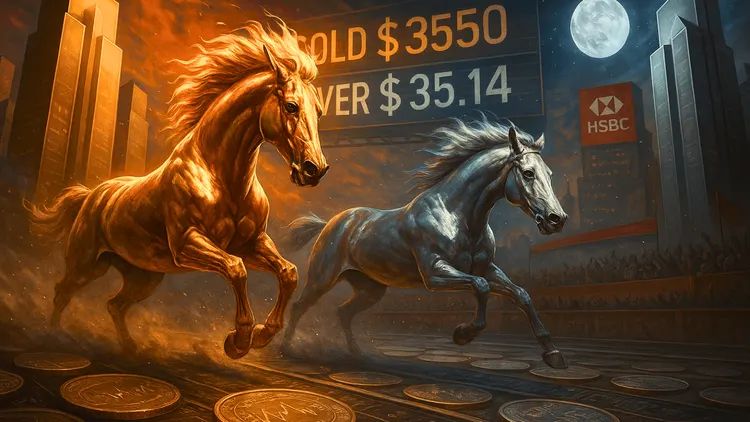
Silver’s fortunes are once again tethered to gold’s meteoric rise, and HSBC believes the next few years could see the white metal riding that momentum to multi-year highs. In its latest market outlook, the bank lifted its Silver Price forecasts from 2025 to 2027, citing gold’s continued strength and silver’s historical tendency to follow in its slipstream.
Gold has been the undisputed star of the commodities market in 2025, climbing nearly 30% since January. The surge reached a fever pitch in April, when escalating tensions from a full-blown global trade war sent investors stampeding toward safe-haven assets. The result was a record-setting $3,500 per ounce, the highest nominal Gold Price ever recorded. Silver, often viewed as the more affordable precious metal, wasted no time in following suit. In fact, its rally outpaced gold’s percentage gains at several points this year, with a particularly dramatic spike in June that propelled it to levels last seen in 2011.
Gold’s “Gravitational Pull” on Silver
HSBC analysts say silver’s latest rally is less about industrial fundamentals and more about gravitational economics. When gold surges, silver tends to be pulled higher by investor sentiment, historical correlation, and the allure of being a cheaper way to gain exposure to precious metals. That gravitational effect was on full display this year, amplified by speculative buying and portfolio diversification strategies.
The bank notes that while gold’s price movement is often driven by macroeconomic and geopolitical risk factors, silver’s performance becomes more volatile, sometimes swinging harder in percentage terms. The June rally, HSBC says, was a textbook case of silver’s high-beta relationship with gold, driven more by gold’s safe-haven momentum than by direct demand shifts in silver’s own market.
Revised Price Forecasts Signal Confidence
HSBC’s upgraded projections suggest a bullish stance on silver well into the latter half of the decade. The bank now sees silver averaging $35.14 per ounce in 2025, up from a prior forecast of $30.28. For 2026, the outlook climbs to $33.96, with 2027 projected at $31.79. The revisions reflect expectations that gold’s elevated pricing will remain a key influence, reinforced by potential macroeconomic catalysts.
One such catalyst could arrive as soon as September, when a widely anticipated US Federal Reserve rate cut could further weaken the dollar and boost precious metal demand. Lower interest rates typically reduce the opportunity cost of holding non-yielding assets like silver and gold, making them more attractive to institutional and retail investors alike.
Industrial Demand: A Mixed Near-Term Picture
While the macro story favors silver, industrial demand is expected to experience a brief pause in 2025. After four consecutive years of record growth, demand from sectors like solar photovoltaics, electronics, and automotive manufacturing will ease slightly. HSBC attributes this slowdown to inventory adjustments and some cooling in global manufacturing activity.
That said, the pullback is not expected to last. By 2026, the bank forecasts a rebound in industrial consumption, led once again by the solar industry’s voracious appetite for silver in photovoltaic cells and the ongoing expansion of electronics production. These structural drivers remain intact, giving silver a dual appeal as both a monetary and industrial asset.
Jewellery and Physical Investment Under Pressure
Not all demand segments are expected to shine equally. HSBC predicts further weakness in jewellery and silverware purchases as high prices push consumers toward more affordable alternatives. Physical investment in the form of coins and bars has also slowed, with many investors having already made substantial purchases during earlier rallies. The combination of elevated prices and a well-stocked retail investor base could keep this segment subdued in the near term.
Supply Growth Could Ease Market Deficits
On the supply side, global mine production is projected to rise modestly over the next three years. This increase should gradually shrink the silver market’s deficit, which HSBC expects will widen to 206 million ounces in 2025 from 167 million ounces last year. By 2026, that gap could narrow to 126 million ounces, easing some of the upward pressure on prices but still leaving the market in a structural shortfall.
The forecasted deficits underscore the challenge of bringing significant new supply online quickly, given the capital-intensive nature of mining projects and the long lead times from exploration to production. Secondary supply from recycling is also expected to remain stable rather than surge.
The Broader Precious Metals Landscape
HSBC’s silver outlook cannot be viewed in isolation from the broader precious metals market. Gold’s dominance in 2025 has reshaped investor positioning, and silver’s reputation as “poor man’s gold” ensures it remains in the conversation whenever gold makes headlines. The white metal’s dual role—as both a monetary hedge and an industrial input—gives it a unique position in the commodity spectrum, allowing it to benefit from both financial and manufacturing trends.
With the global economy navigating trade frictions, interest rate shifts, and energy transitions, silver is poised to remain in the spotlight. The gravitational pull of gold’s record-breaking run is powerful, but silver’s own fundamentals—especially the ongoing demand from renewable energy and electronics—mean it has more than one reason to shine.
Conclusion
HSBC’s forecast revisions paint a clear picture: silver’s path in the coming years will be heavily influenced by gold’s trajectory, but its industrial backbone will ensure it remains more than just a passenger. With price projections climbing and structural deficits persisting, silver could find itself in a sweet spot where financial and industrial demand converge. Whether investors see it as a hedge, a growth play, or both, the metal’s role in the global economy looks set to grow.