
From Boom to Gloom: AI Stocks Take Wall Street Down
AI darlings lose shine as Wall Street braces for Powell’s Jackson Hole speech and retail earnings deliver a mixed bag.
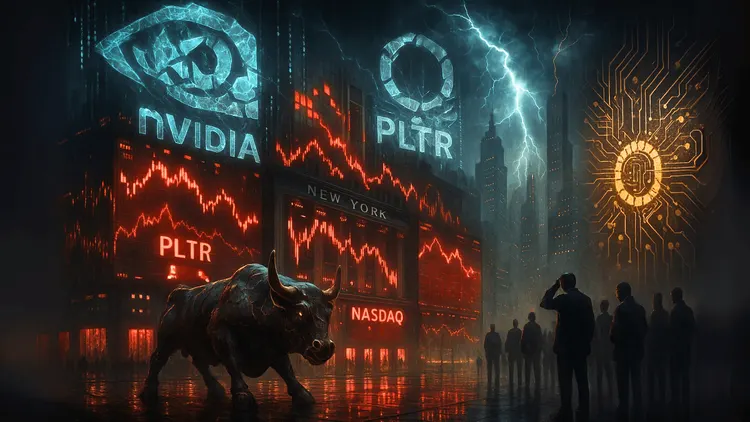
Wall Street’s red-hot romance with artificial intelligence stocks is showing its cracks. After months of meteoric gains, Nvidia, Palantir and other AI-driven companies have turned into the heaviest anchors on the U.S. markets. The S&P 500 fell 0.5 percent on Wednesday, logging its fourth consecutive loss, while the Nasdaq tumbled more than 1 percent. The Dow Jones Industrial Average managed to hold relatively steady, down just 30 points. But the clear takeaway was this: the same AI names that fueled Wall Street’s rally are now leading its retreat.
Nvidia and Palantir Under Pressure
Nvidia’s dominance in powering the AI boom is unquestioned, but investors are beginning to question its valuation. The stock dropped another 1.3 percent Wednesday after a 3.5 percent slide the day before. At one point, Nvidia’s losses deepened to nearly 4 percent before paring back, reflecting shaky confidence ahead of next week’s critical earnings report. Palantir, which had more than doubled this year on the AI wave, sank 2.3 percent, extending a brutal two-day loss that wiped nearly 12 percent from its market value.
The pullback reflects growing unease that AI optimism may have gotten ahead of reality. A recent MIT study from the Nanda Initiative suggested most corporations are not yet seeing measurable returns from generative AI projects, underscoring the gap between hype and hard results. UBS Global Wealth Management strategist Ulrike Hoffmann-Burchardi noted that the issue is less about technology’s potential and more about the fact that stock prices surged too far, too fast.
The Retail Rollercoaster
While AI stocks stole the spotlight, retail earnings also shaped trading. TJX, parent of TJ Maxx and Marshalls, surged more than 3 percent after reporting strong demand across its U.S. and international businesses, prompting the company to raise full-year profit guidance. Lowe’s added modest gains after beating profit expectations and unveiling an $8.8 billion acquisition of Foundation Building Materials.
But the pain was sharper for others. Target plunged more than 7 percent after announcing CEO Brian Cornell will step down early next year, to be replaced by long-time insider Michael Fiddelke. Despite Cornell’s success in reinvigorating the brand, the retailer has struggled to revive sales in a post-pandemic retail environment. Estee Lauder shed 5.3 percent after forecasting weaker profits tied to tariff costs, while La-Z-Boy nosedived 12 percent following disappointing quarterly results.
Eyes on the Federal Reserve
The market’s jitters extend beyond earnings. All eyes are turning to Jackson Hole, Wyoming, where Federal Reserve Chair Jerome Powell is set to deliver a closely watched speech on Friday. Powell’s remarks could signal whether the Fed is finally ready to cut interest rates after keeping them steady this year. Tariffs from President Donald Trump’s administration have threatened to keep inflation stubborn, but a recent weak jobs report has shifted expectations toward potential easing.
Treasury yields are already adjusting, with the 10-year yield falling to 4.28 percent. The move suggests traders are bracing for a Fed that might prioritize growth support over inflation fears in the coming months.
Global Markets Send Mixed Signals
Overseas markets added another layer of uncertainty. London’s FTSE 100 rose 1.1 percent despite hotter-than-expected inflation data, fueled by rising airfares and food costs. Tokyo’s Nikkei 225 fell 1.5 percent after Japanese export numbers came in worse than anticipated under the weight of U.S. tariffs. Hong Kong’s Hang Seng, however, managed a 0.2 percent lift, driven by Pop Mart International’s 12.5 percent surge following bullish revenue guidance and the launch of new collectible products.
The mood on Wall Street is shifting from exuberance to caution. Nvidia, Palantir and their AI peers remain central to the market’s future, but investors are grappling with whether valuations reflect near-term reality or long-term promise. For now, uncertainty is winning, dragging the broader indexes lower. The balance of hype and hard results in AI, combined with looming Fed policy decisions, will likely dictate where markets head next.
Wall Street has seen this movie before—when innovation sparks euphoria, only for the hard math of profits and policy to bring investors back to earth. The AI revolution may indeed be transformative, but as this week’s trading shows, even the brightest stars can flicker.
Conclusion
Nvidia and Palantir, once the poster children of Wall Street’s AI obsession, are now reminders of how quickly sentiment can swing. Retail earnings and Federal Reserve uncertainty added to the turbulence, painting a picture of a market at a crossroads. The question for investors is no longer just how powerful AI could become, but how much they are willing to pay for that promise today.