
Finland Outshines Canada in Latest Fraser Mining Report
Policy clarity and regulatory stability put Finland back on top, while Canada struggles with political gridlock and permitting woes.
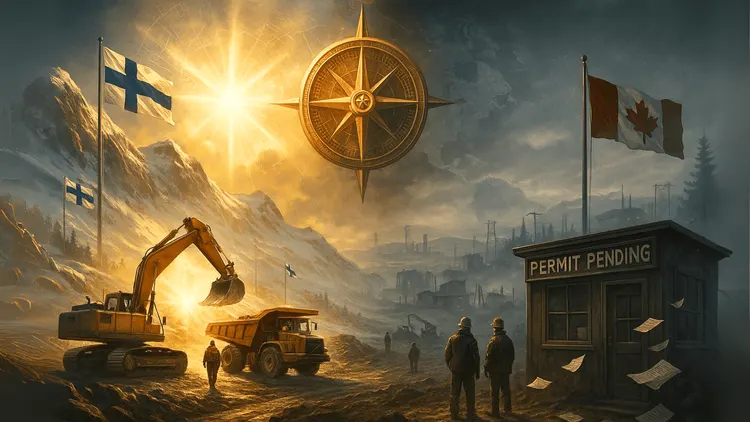
Finland is back on top. After more than a decade away from the spotlight, the Nordic nation has reclaimed its title as the world’s most attractive jurisdiction for mining investment, according to the Fraser Institute’s 2024 Annual Survey of Mining Companies. Once again, geology and governance have aligned in Helsinki’s favor, setting the tone for what could be a seismic shift in global mining strategies.
The survey, which ranks 82 global regions based on a combination of mineral potential and public policy, has long been the industry’s trusted barometer. This year’s report, however, sends a resounding message. Finland isn’t just back—it’s dominating. Trailing behind are Nevada and Alaska, followed closely by Wyoming and Arizona. Meanwhile, Canada, long a powerhouse in the sector, is struggling to hold onto its former glory. Saskatchewan and Newfoundland and Labrador are the only two Canadian provinces to secure spots in the top 10, and even they slipped in rankings compared to previous years.
Canada’s decline is not due to a lack of geological riches. It’s political and regulatory uncertainty that’s chasing investors away. Indigenous land claims, fragmented permitting processes, and changing environmental rules are clouding the country’s appeal. Yukon, British Columbia, and Manitoba all possess high mineral potential, yet they languish in the lower half of the rankings once policy is factored in. Ontario slid to 15th and Quebec plummeted from fifth to 22nd, reflecting mounting concerns over taxation and bureaucratic roadblocks.
Sean Kirby, executive director of the Mining Association of Nova Scotia, minced no words. He blamed Nova Scotia’s dismal 2024 ranking on a permitting system plagued by inefficiency and disconnection from actual mining expertise. According to Kirby, geoscientists in the Department of Natural Resources are being sidelined by regulators with little to no mining background. It’s a structural flaw that’s costing the province jobs and investment. While Nova Scotia holds vast potential in critical minerals and other resources, that promise is being throttled by an outdated regulatory regime.
Contrast that with Finland, where consistency and clarity reign. The Finnish government’s collaborative approach with industry, coupled with a streamlined permitting framework and strong environmental governance, is delivering precisely what global investors want: certainty. In a capital-intensive, high-risk industry like mining, policy stability is as valuable as the resources in the ground.
The Annual Survey of Mining Companies is compiled based on responses from around 350 mining professionals worldwide, with 40 percent representing exploration companies and 32 percent from producers. Participants assessed dozens of factors ranging from labor availability and infrastructure to taxation and socio-environmental risk. While mineral endowment is foundational, the survey has consistently found that jurisdictions with stable, predictable regulations outperform even those with richer geology.
Ireland topped the rankings when policy alone was considered, showing that even in regions without blockbuster deposits, smart governance can create a compelling investment case. On the other end of the spectrum, Bolivia and Mozambique fell to the bottom due to chaotic regulatory environments and unreliable enforcement.
The Fraser Institute's findings hit especially hard in Canada, where the nation’s reputation as a global mining hub is under increasing strain. In 2023, four Canadian provinces were ranked in the global top 10. In 2024, only two remain. It’s not a trend—it’s a warning.
The broader message for Canada is clear. While the geology hasn’t changed, the politics have. And in the resource sector, perception drives capital. There’s hope, though. Since the survey period ended last December, Canada has undergone substantial political change. Mark Carney’s election as prime minister in early 2025 signaled a pivot toward more pragmatic, pro-growth leadership. His administration has already introduced new legislation aimed at streamlining approvals for major resource projects, while several provinces have followed suit with reforms intended to reduce duplication and accelerate permitting.
The early response from industry has been cautiously optimistic. If Carney’s reforms take root quickly, they could help reverse the decline and restore Canada’s competitiveness in next year’s survey. But it won’t be easy. Trust takes time to rebuild. Investors are watching closely, and the world is no longer waiting.
The resurgence of Finland, paired with the rise of U.S. jurisdictions like Nevada and Alaska, suggests a broader shift toward regions that prioritize certainty and efficiency. The geopolitics of critical minerals, from lithium to cobalt and rare earths, are also influencing these dynamics. As the race to secure clean energy inputs accelerates, jurisdictions that offer not just resource abundance but regulatory agility will attract the lion’s share of investment.
Canada is at a crossroads. It can double down on its strengths—world-class geology, skilled labor, and deep mining expertise—or continue down the path of policy fragmentation and investor flight. The Fraser Institute’s 2024 survey isn’t just a ranking. It’s a reflection of where the world’s mining capital is flowing—and why. Finland listened. The question is, will Canada?