
Elon Musk’s New Party, Tesla’s New Problem
Elon Musk's bold political gamble sends Tesla stock tumbling, as investors fear a distracted CEO and escalating tensions with Trump could destabilize the company’s future.
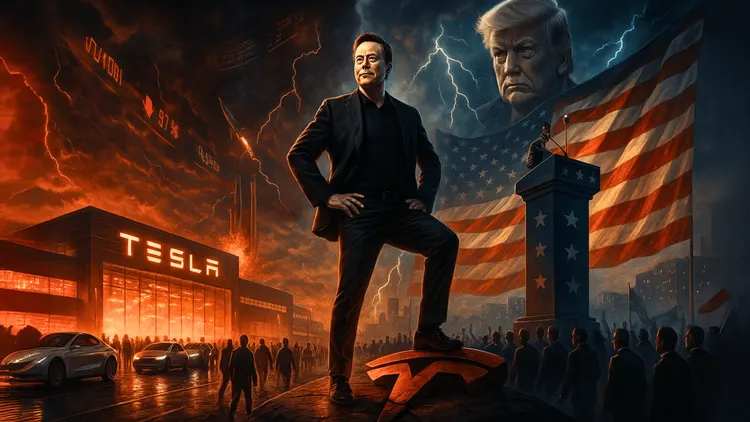
Tesla’s stock took another beating on Monday morning, dropping nearly 7 percent in premarket trading after CEO Elon Musk revealed plans to launch a new U.S. political party. The announcement—coming just days after Tesla reported declining deliveries for a second straight quarter—has amplified already mounting investor concerns about Musk’s focus. The new political vehicle, dubbed the “America Party,” surfaced after Musk publicly clashed with President Donald Trump over the administration’s recent tax-cut and spending policies. What started as a simmering policy disagreement exploded into a public feud, culminating in Musk's decision to launch his own political brand.
For investors, the message was loud and clear. Musk, the brain behind Tesla’s meteoric rise, isn’t just doubling down on politics—he’s potentially shifting his energy away from the company at a time when it desperately needs focus and leadership. While Tesla is no stranger to controversy, this move sent a ripple of unease through financial markets that were already jittery over the company’s recent performance.
The Cost of Distraction
Elon Musk has always been a polarizing figure. His leadership style, unpredictable tweets, and tendency to juggle multiple ventures—from rockets and brain chips to tunnel-digging and AI—have long been both his genius and his Achilles' heel. But his renewed political ambitions are stoking fears that he’s now too distracted to guide Tesla through one of the most challenging periods in its history. As competition heats up in the EV space and Tesla’s product line matures without a major refresh, investors are craving stability. Instead, they’re getting headlines.
Strategists like Neil Wilson of Saxo Markets have framed the concern in stark terms. Investors aren’t just worried about Musk drawing the ire of Trump and potentially endangering federal subsidies for Tesla and SpaceX. They’re equally alarmed that Musk is increasingly turning his attention away from the company. Tesla stock, which hit a record high just months ago, has now dropped more than 35 percent since Trump’s re-election in November. That slide makes Tesla the worst-performing member of the so-called Magnificent Seven tech giants in 2025.
Backpedaling on Promises
Just two months ago, Musk had appeared to do exactly what shareholders wanted. He pledged to reduce his political involvement and committed to remaining Tesla’s CEO for another five years. That move came after he had poured nearly $300 million into supporting Trump’s campaign, raising eyebrows across corporate America. But his weekend pivot back into politics—with a fresh plan to challenge the status quo—has rattled the very investors who had applauded his earlier retreat.
It’s a return to form that’s no longer playing well on Wall Street. “There’s a sense of exhaustion,” said Wedbush analyst Dan Ives, a longtime Tesla supporter. “Investors are worn out watching Musk’s political battles play out in real time while delivery numbers slide and competition ramps up.”
Adding fuel to the fire, investment firm Azoria Partners—once bullish on Tesla—has now delayed the listing of a Tesla-focused exchange-traded fund. In a rare public critique, Azoria CEO James Fishback slammed Musk’s America Party rollout and called on Tesla’s board to address whether the CEO’s political involvement still aligns with his executive responsibilities.
A Board Under Scrutiny
Fishback’s comments highlight a growing chorus of voices questioning the Tesla board’s role in managing Musk. Tesla Chair Robyn Denholm recently denied reports suggesting the board was exploring options to replace Musk. But that denial has done little to quell investor anxiety. Critics argue that Tesla’s board has repeatedly failed to rein in Musk’s more controversial moves, raising doubts about its ability—or willingness—to provide effective oversight.
Legal experts are also chiming in. Ann Lipton, a business law professor at the University of Colorado, argued that this is exactly the type of moment where a strong board would step in. “If a CEO refuses to limit behavior that distracts from the company’s goals, that’s when you start having serious governance conversations,” Lipton said. Yet the Tesla board, she added, has a track record of passivity that makes intervention seem unlikely.
The board’s challenge is compounded by Musk’s unique standing. He’s not just Tesla’s CEO—he’s its cultural core. Replacing him would spark its own kind of chaos. But letting him drift deeper into political waters risks turning Tesla from a market leader into a cautionary tale.
A Fragile Moment for Tesla
This isn’t just about politics. Tesla is at a critical inflection point. The electric vehicle market is more crowded than ever, with legacy automakers, Chinese upstarts, and tech giants all elbowing into the space. Tesla’s once-revolutionary lineup is beginning to show its age. And after years of rapid growth, the company is struggling to sustain momentum.
Musk’s genius and boldness helped Tesla dominate the last decade of automotive innovation. But in 2025, consistency might matter more than charisma. For investors betting on Tesla’s future, the fear is that their CEO is now more interested in building political capital than shareholder value.
The Trump Factor
Donald Trump’s role in this saga cannot be understated. His threat to pull billions in federal subsidies has raised legitimate questions about the stability of Tesla’s government-backed revenue streams. Musk’s companies—from Tesla to SpaceX—rely heavily on federal contracts and support. A hostile administration could dramatically impact their bottom lines.
By antagonizing Trump, Musk risks turning the political environment against his entire ecosystem. His new party may be born of personal conviction or strategy, but for Tesla shareholders, it looks increasingly like a liability.
A Crisis of Confidence
Confidence in leadership is a pillar of investor sentiment. Right now, that confidence is cracking. Tesla’s decline is more than just a reaction to a bad quarter or two. It’s a reflection of deeper doubts about direction and discipline.
Musk’s America Party might be his most audacious project yet, but it’s also his most distracting. Whether Tesla’s board steps up or continues to stay silent could shape the company's fate for years to come. The market isn’t just watching Musk’s moves. It’s watching who, if anyone, is willing to say enough is enough.
Conclusion
Tesla’s slide isn’t just about deliveries or subsidies. It’s about trust. Investors are once again questioning whether Elon Musk can focus on running the company he built into a global icon, or whether his political ambitions have finally become too big to ignore. As the America Party takes shape and the board faces pressure, Tesla stands at a crossroads. What happens next may depend less on the road ahead and more on whether its driver decides to stay behind the wheel.