
Atomic Servers: How Oklo Powers the AI Boom
Nuclear innovation meets digital infrastructure in a high-powered partnership set to redefine energy and cooling for AI-era data centres.
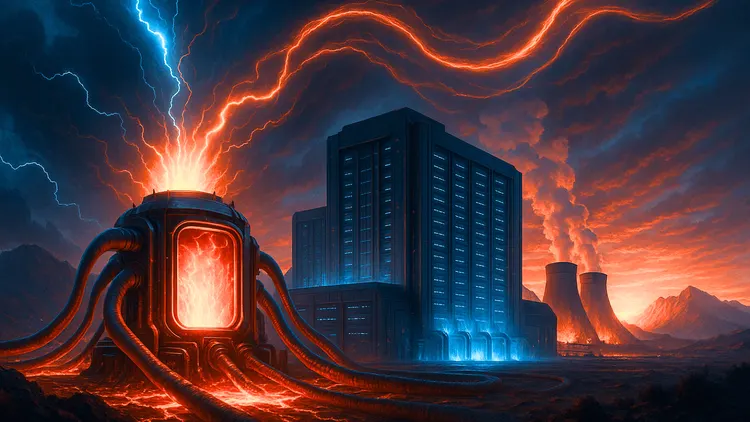
In a landmark partnership that fuses nuclear innovation with digital infrastructure, Oklo Inc and Vertiv have announced a strategic collaboration to develop modular, high-efficiency power and thermal management solutions for hyperscale and co-location data centres. The union signals a bold step toward transforming the energy backbone of data centres—those sprawling, power-hungry vaults of AI computation and cloud services—by anchoring them in advanced nuclear power.
California-based Oklo is known for its fast-moving approach to next-generation nuclear, developing liquid metal-cooled fast reactors that produce both clean electricity and usable heat. Now, through its collaboration with Vertiv, a global leader in critical digital infrastructure, Oklo aims to put its compact Aurora reactor technology at the heart of an energy and cooling revolution for the data economy.
What makes this partnership uniquely powerful is the convergence of two critical needs. First, the insatiable energy demand of modern data centres, especially those powering artificial intelligence, edge computing, and high-density workloads. Second, the growing call for sustainable, reliable, and scalable energy sources that can meet these demands without choking the planet. Oklo and Vertiv believe they have the answer—a unified nuclear-powered solution that co-optimizes power delivery and cooling from the ground up.
The Aurora powerhouse at the center of this vision is a 15 megawatt electric (MWe) fast neutron reactor using metallic fuel and heat pipe technology to transport energy efficiently to a supercritical carbon dioxide power conversion system. It’s a compact, resilient plant that can generate both electricity and industrial-grade heat, and it operates on either fresh HALEU (High-Assay Low-Enriched Uranium) or recycled nuclear fuel. That versatility makes it not only clean, but exceptionally adaptable to long-term operations and varying regulatory conditions.
By combining Aurora’s steam and electricity with Vertiv’s cutting-edge cooling and power systems, the companies aim to co-design data centres with unprecedented integration between the energy source and the infrastructure it powers. This means using waste heat from the reactor to directly drive Vertiv’s cooling systems, dramatically improving energy efficiency and reducing the traditional need for separate mechanical chillers or carbon-intensive power grids.
The companies will produce full reference designs for data centres built adjacent to Oklo’s reactors, forming self-contained campuses of compute, power, and cooling. These designs won’t just be theoretical. The partnership will debut with a pilot demonstration project using the first commercial Aurora reactor at the Idaho National Laboratory, slated to begin operations between late 2027 and early 2028. If successful, this could open the floodgates to commercial deployments across North America and beyond.
For Oklo CEO Jacob DeWitte, the vision is crystal clear. “This agreement is about delivering clean power, energy-efficient cooling, and infrastructure solutions purpose-built for AI factories, data centres, and high-density compute,” he said. “By co-designing from day one and deploying on-site, we’re making it easier, faster, and cheaper to power the digital world responsibly.”
DeWitte emphasized that the project draws on proven, off-the-shelf components, which helps keep timelines short and engineering risks low. Rather than forcing data centres to retrofit or adapt to nuclear, the two companies are designing together from scratch. That means building energy systems and cooling systems as one unit—rather than as competing silos—allowing operators to maximize performance while simplifying installation and operations.
Vertiv CEO Giordano Albertazzi echoed that sentiment, noting that their customers, from hyperscalers to enterprise cloud providers, are already looking seriously at nuclear energy as the next frontier. “Our collaboration with Oklo is an extension of Vertiv’s commitment to energy-efficient infrastructure that supports modern data centre demands. As the demand for AI and high-performance computing continues to grow, nuclear energy is increasingly a discussion point for hyperscale, colocation, and other large data centres,” he said.
That’s not just marketing optimism. Data centre operators are under mounting pressure from investors, governments, and communities to slash emissions while maintaining uptime. At the same time, electricity grids in many regions are stretched thin, leaving data centre expansions dependent on new transmission infrastructure or alternative sources like natural gas and diesel. That’s where nuclear comes in—not as an alternative, but as an embedded part of the infrastructure, built right next to where the power is needed most.
The strategic importance of this deal also lies in timing. As global demand for artificial intelligence explodes and data sovereignty concerns prompt companies to decentralize infrastructure, there’s a golden window of opportunity to redefine how the world’s digital infrastructure is powered and cooled. If Aurora-powered data centres can demonstrate superior economics, scalability, and environmental performance, Oklo and Vertiv may well set the blueprint for how future tech campuses are built.
There are also geopolitical tailwinds. The US government has been ramping up support for domestic nuclear innovation and critical infrastructure through various initiatives, including DOE funding programs, HALEU fuel development, and fast-track permitting. A successful demonstration at Idaho National Lab would not only validate Oklo’s approach but could also place it squarely in the center of the country’s next-generation energy strategy.
In essence, Oklo and Vertiv are betting that the future of the internet, AI, and data won’t be sustained by fossil fuels or strained grids. It’ll be run by next-gen nuclear plants that are compact, clean, and always on. And they’re not just building power plants. They’re building a template for a new kind of energy economy—one that treats electrons and cooling as an integrated service, not a patchwork of disconnected parts.
If this collaboration delivers what it promises, it could do more than just power data centres. It could redefine them.
Conclusion
The Oklo-Vertiv alliance represents a pivotal moment for both energy and digital infrastructure. By bringing together small-scale nuclear power and intelligent cooling in a unified, site-adjacent solution, the partnership addresses two of the most pressing challenges of the modern digital age: sustainability and scalability. As data centre loads grow exponentially, and as the need for clean, resilient power becomes non-negotiable, this collaboration stands to change the game—not just for data centres, but for how the world powers its digital future.